
Warehouse gas safety checks help London business owners prevent leaks, carbon monoxide exposure, and breakdowns that disrupt operations. UK law requires gas systems to be designed, installed, and maintained by Gas Safe registered engineers, with annual checks as a minimum and extra inspections for high‑demand or altered systems. Proper checks cover appliances, pipework, ventilation, and emergency isolation. Accurate gas safety records support compliance, insurance, and risk management. The key points below outline what every warehouse operator should understand.
Key Takeaways
- Warehouse gas safety checks protect staff, stock, and operations by preventing leaks, carbon monoxide exposure, and sudden equipment failures.
- UK law requires commercial gas systems to be designed, installed, and maintained by appropriately qualified, Gas Safe registered engineers.
- Most London warehouses need at least annual gas safety inspections, with extra checks after modifications, incidents, or before peak operating seasons.
- Regular checks must cover pipework integrity, burner performance, ventilation, flues, and clearly identified emergency isolation valves.
- Keep up‑to‑date Gas Safety Records and certificates, as insurers, landlords, and regulators rely on them to verify compliance and risk control.
Table of Contents
Why is Warehouse Gas Check Important?
A warehouse gas check safeguards staff, stock, and operations from the often unseen risks posed by gas-powered heating, appliances, and industrial equipment. It confirms that burners, pipework, and ventilation are working as intended, so owners are not gambling with leaks, hidden carbon monoxide, or sudden equipment failure. By uncovering problems early, it avoids disruptive shutdowns that can trap a business in costly downtime.
For London owners who value flexibility and control, gas checks protect the freedom to operate on their own terms. A single undetected fault can trigger fire, explosion, or poisoning, destroying inventory and infrastructure in minutes and inviting investigations, claims, and reputational damage. Routine checks, carried out by competent professionals, turn guesswork into certainty. They provide evidence that systems are safe to run, that risks are actively managed, and that people can work, move, and store goods without relying on luck.

UK Regulations for Warehouse Gas Safety
Although every warehouse operates differently, gas safety in the UK is governed by a clear framework of regulations that applies to all commercial sites. Core duties flow from the Health and Safety at Work etc. Act 1974, the Gas Safety (Installation and Use) Regulations 1998, and the Dangerous Substances and Explosive Atmospheres Regulations 2002 (DSEAR). Together, these laws set non‑negotiable standards while leaving businesses free to choose how they comply.
A warehouse operator must guarantee gas systems are designed, installed, and maintained by Gas Safe registered engineers, with risks assessed, documented, and controlled. Where gas is stored, moved, or burned, employers must evidence that exposure and explosion risks are reduced “so far as is reasonably practicable”.
| Regulation / Standard | Core Duty | Freedom Within the Rules |
| HSWA 1974 | Provide safe workplace | Choose methods |
| GSIUR 1998 | Safe gas systems | Select contractors |
| DSEAR 2002 | Control explosion risk | Tailor controls |
| PUWER 1998 | Safe equipment use | Pick technology |
| Local bylaws | Site‑specific limits | Plan operations accordingly |
What Is Included in a Gas Safety Check?
During a warehouse gas safety check, a competent Gas Safe registered engineer systematically inspects every part of the gas system that could affect safety. The process normally begins with confirming the engineer’s credentials and reviewing any previous records, giving owners a clear trail of accountability and control over their risk.
The engineer then checks gas pipework for integrity, correct sizing, and secure routing, guaranteeing there are no leaks or vulnerable joints. Tightness tests are carried out on the entire installation, using calibrated equipment to confirm the system holds pressure within legal limits.
Ventilation pathways and combustion air supply are examined to verify gas burns cleanly and safely, preventing dangerous build‑ups. Flues and chimneys are visually assessed to confirm they remove products of combustion effectively.
Finally, emergency isolation valves and accessible labels are verified so that, if something goes wrong, warehouse teams can act quickly and independently.
Warehouse Gas Appliances and Equipment
Gas appliances in warehouses range from industrial space heaters and radiant tube heaters to gas‑fired boilers, process burners, and powered forklift charging equipment, each presenting distinct safety considerations. In busy London warehouses, this equipment underpins productivity, but it also concentrates gas pipework, ignition sources, and exhaust products in the same space where people need freedom to move and work without constant worry.
Key risk points include gas leaks from ageing pipework, damaged flexible hoses on appliances, poor ventilation around combustion equipment, and unauthorised modifications by unqualified staff. Cylinders used for LPG‑powered tools or vehicles introduce additional hazards if stored or handled casually.
To protect staff and preserve operational flexibility, owners typically focus on:
- Correct location and mounting of appliances
- Integrity of gas pipework and connections
- Safe cylinder storage and changeover areas
- Ventilation routes and flue terminations
- Clear emergency isolation points and labelling
Gas Safety Checks for Boilers and Heaters
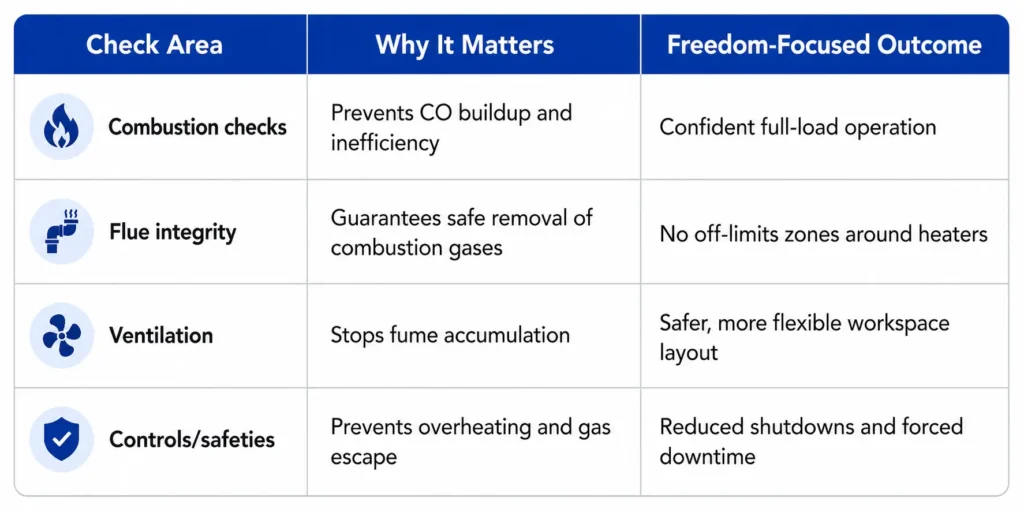
While a wide range of warehouse gas appliances demand attention, boilers and space heaters usually represent the most continuous and high‑input gas use on site. For owners who value operational freedom, these appliances must be checked so they can run hard without boxing teams in with risk or restrictions. A competent Gas Safe engineer will verify correct combustion, flue integrity, ventilation, burner performance, and control settings, documenting any limits on safe operation. You must know What Happens if a Boiler Fails a Safety Check?
How Often Should Warehouse Gas Checks Be Completed?
Many London warehouse owners find that the right gas check frequency depends on both legal duties and the intensity of on‑site operations. Annual inspections remain the baseline expectation, but busy sites, 24/7 shifts, or older pipework usually justify more frequent checks to keep people safe and operations uninterrupted.
In practice, frequency is guided by risk level, type of gas equipment, and how hard that equipment is pushed. A structured approach helps owners protect staff while keeping workflow flexible rather than restricted by constant emergency repairs.
Key patterns usually include:
- Formal gas safety check at least once every 12 months
- Six‑monthly inspections where high‑demand heaters or appliances run constantly
- Quarterly visual walk‑throughs to spot obvious damage, leaks, or tampering
- Extra checks immediately after any modification, incident, or unexplained gas smell
- Short recorded checks before peak seasons, such as winter, when heating demand jumps
Who Is Responsible for Warehouse Gas Safety?
Responsibility for warehouse gas safety in London does not sit with a single person or job title; it is shared, but clearly defined in law. The primary legal duty usually rests with the “duty holder”: typically the business owner, leaseholder, or managing director with control over the premises. They must guarantee systems are safe, compliant, and regularly checked by qualified engineers.
Landlords who retain responsibility for fixed gas installations must arrange inspections and maintenance under the Gas Safety (Installation and Use) Regulations and the Health and Safety at Work etc. Act. Managing agents may carry contractual duties, but legal accountability still traces back to the duty holder and landlord.
Competent Gas Safe registered engineers hold responsibility for carrying out work to recognised standards. Line managers and supervisors are responsible for enforcing safe operating procedures, while workers must follow training, report concerns, and avoid unauthorised gas-related tasks that could compromise collective safety and operational freedom.
Common Gas Safety Issues in Warehouses
Common gas safety issues in warehouses tend to arise from a predictable set of weak points: poorly maintained appliances, ageing pipework, inadequate ventilation, and defective flues. These weaknesses quietly limit a business owner’s freedom to operate without disruption, exposing staff and assets to unnecessary risk.
Typical problems include damaged or corroded pipework hidden behind racking, untested heaters running constantly through winter, and makeshift alterations carried out during busy periods. Forklift traffic, pallet impacts, and building movement can all disturb joints and fittings over time.
Key issues often seen in London warehouses include:
- Unauthorised appliance modifications or DIY repairs
- Blocked or undersized vents and flues
- Gas appliances installed too close to combustible stock
- Leaking flexible hoses on heaters or process equipment
- Faulty or absent emergency isolation valves and signage
Gas Safety Records and Certification
Although gas systems in warehouses are often out of sight, the law treats their documentation as a frontline safety control. For London business owners who value freedom to operate without interference, accurate gas safety records act as a protective shield. They demonstrate that legal duties have been met and that risks to staff, visitors, and contractors are being actively managed.
Gas safety records typically include details of each appliance, test results, identified defects, and remedial actions. Annual gas safety certificates, often required by insurers and landlords, confirm that checks have been completed in line with regulations such as the Gas Safety (Installation and Use) Regulations 1998.
Orderly, accessible documentation reduces the chance of enforcement action, limits downtime after an incident, and supports smooth handovers when businesses expand, relocate, or sublet. In practice, robust record‑keeping preserves operational autonomy by showing regulators that the warehouse is under responsible, disciplined control.

Choose a Qualified Gas Safety Engineer
Selecting a qualified gas safety engineer is a critical safeguard for any London warehouse that uses gas-fired equipment. Business owners who value independence and control over operations recognise that only a competent, legally-registered engineer can provide the assurance needed to run without interruption or hidden risk.
Key checks include:
- Verified Gas Safe registration, with licence details matching the engineer on site.
- Specific qualifications for commercial and industrial appliances, not just domestic systems.
- Demonstrable experience with warehouses, including ventilation, loading bays, and plant rooms.
- Clear, itemised quotations that outline checks, testing methods, and any remedial work.
- Professional insurance and a commitment to issuing compliant Gas Safety Records.
Frequently Asked Questions
How Can I Train Warehouse Staff to Recognise Early Gas Leak Signs?
They can train staff through short, scenario-based drills, practical demos of smell, sound, and visual cues, clear checklists, peer-led toolbox talks, and regular refresher sessions that empower workers to act immediately, report concerns, and evacuate independently.
What Emergency Procedures Should We Implement for a Suspected Warehouse Gas Leak?
They should establish clear alarm triggers, immediate evacuation routes, muster points, shutdown of gas and electrics, no-ignition rules, ventilation protocols, accountability headcounts, emergency services contact steps, communication chains, drills, and post-incident reviews empowering staff to act decisively.
How Do Gas Safety Checks Differ Between Automated and Manual Warehouses?
Gas safety checks differ through sensor density, inspection access, and procedural control. Automated sites emphasise continuous monitoring, remote isolation, and software audits; manual warehouses rely more on physical inspections, staff training, evacuation drills, and visible shut‑off points.
Can Gas Monitoring Be Integrated With Our Existing Warehouse Management Systems?
Yes, integration is usually possible; gas monitoring platforms can feed live data into most WMS via APIs, Modbus, or OPC. This lets operators automate alerts, trigger workflow pauses, log incidents, and maintain independent oversight.
What Design Changes Improve Gas Safety in New or Refurbished Warehouse Buildings?
Design changes include zoned ventilation, high/low-level extraction, intrinsically safe electrics, segregated gas storage, automatic shut-off valves, continuous fixed detection, clear escape routes, minimal obstructions, roof vents, and open layouts that keep staff mobile, informed, and in control.
Conclusion
In conclusion, warehouse gas safety checks are essential for protecting staff, property, and business continuity in London. By complying with UK regulations, maintaining appliances, and scheduling regular inspections, businesses greatly reduce the risk of gas leaks, carbon monoxide incidents, and costly downtime. Keeping accurate gas safety records and using qualified Gas Safe registered engineers guarantees legal compliance and long-term peace of mind, reinforcing a culture of safety across every aspect of warehouse operations.