
In the UK, landlords must arrange a full Electrical Installation Condition Report (EICR) at least every five years for most rented properties. A basic electrical safety check is a lighter, visual inspection and is optional, used mainly between EICRs or after minor works. It does not meet legal requirements on its own. Only a valid EICR satisfies councils, agents and insurers, while routine safety checks can support ongoing compliance and raise fewer surprises once the differences are understood.
Key Takeaways
- An EICR is a full legal electrical inspection required at least every five years for most private rented homes in England and Wales.
- A basic electrical safety check is a lighter, mainly visual review and does not satisfy the legal requirement for an EICR.
- Landlords must obtain and keep a valid EICR, act on C1/C2 faults promptly, and provide reports to tenants, councils, or agents when requested.
- Use basic electrical safety checks between EICRs, after minor works, or when tenants raise concerns, to spot visible faults early.
- Schedule the EICR before advertising or starting a new tenancy; use interim checks only as a supplement, never as a replacement.
Table of Contents
What Is an Electrical Safety Check?
An electrical safety check is a structured assessment of a property’s electrical installation and equipment to confirm they are in safe working condition and compliant with current regulations. It allows a landlord to let people live, work, and move about the space without hidden electrical hazards limiting their choices or peace of mind.
The check typically covers fixed wiring, sockets, switches, consumer units, protective devices, and any accessible electrical accessories. A competent person visually inspects and tests for damage, wear, overloading, and signs of overheating. They also verify basic safety features, such as earthing and bonding, operate correctly. The outcome is usually a clear list of any issues, graded by urgency, so a landlord can act decisively and keep the property safely usable.

What Is an EICR?
An Electrical Installation Condition Report (EICR) is a formal, standardised document produced after a detailed inspection and testing of a property’s fixed electrical installation. It records the condition of consumer units, wiring, sockets, switches, and all other fixed components, highlighting whether they remain safe to use and compliant with current regulations.
The process is carried out by a qualified electrician, who tests circuits, checks protective devices, and looks for deterioration, damage, or unsafe alterations. Observations are coded by risk level, so issues threatening safety or continuity of use are easy to prioritise and plan around. For landlords who value flexibility and minimal interference, an EICR offers clear evidence of electrical safety while helping them avoid unexpected failures and restrictive emergency works.
Which One Do Landlords Need?
So which type of check actually satisfies a landlord’s legal duties? In England and Wales, the law is clear: for most private rented homes, landlords must have a valid Electrical Installation Condition Report, carried out at least every five years, or sooner if the report says so. A generic “electrical safety check” with no formal EICR report usually will not meet statutory obligations.
Landlords who value autonomy and minimal state interference still need to recognise that, in practice, the EICR is the document councils and insurers expect. It proves that fixed wiring, consumer units, and permanent circuits have been tested by a competent person. Without this, landlords risk enforcement action, fines, and restrictions on their ability to let property.
Does a Safety Check Replace an EICR?
Given that the law expects landlords to hold a valid EICR, the next question is whether a simpler electrical safety check can act as a substitute. In legal terms, the answer is no. A routine safety check, even when performed by a competent electrician, does not meet the statutory requirement for a full Electrical Installation Condition Report.
Landlords may prefer lighter, quicker inspections to keep control over cost and intrusion, but regulation focuses on documented evidence and traceable responsibility:
| Aspect | Safety Check vs EICR Meaning for Landlords |
| Legal status | EICR only |
| Depth of testing | Limited vs thorough |
| Evidence for enforcement | Informal notes vs formal report |
| Accountability of contractor | Less defined vs clearly recorded |
| Protection in disputes | Weak vs strong, audit‑ready documentation |
When a Basic Electrical Check Is Useful
Many day‑to‑day situations in a rented property are better suited to a basic electrical check than a full EICR. Landlords who want to keep things light‑touch yet responsible often use these checks between formal inspections, after small works, or when new tenants move in and raise casual concerns.
A basic check is useful for verifying visible elements: socket fronts, switches, light fittings, cooker points, and obvious cable damage. It can quickly confirm that RCD test buttons operate, breakers reset, and accessories are not overheating or cracked.
This kind of visit helps a landlord act early without committing to major investigation, supporting safety while preserving flexibility, budget control, and minimal disruption to tenants’ everyday freedom in the property.
When an EICR Is Required
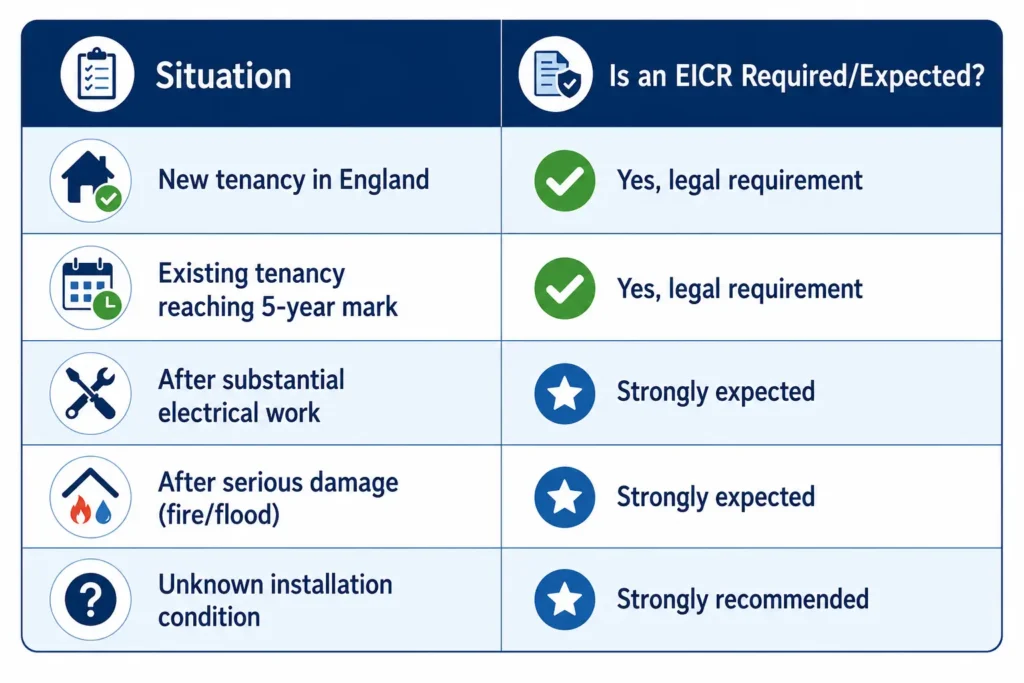
Occasionally, only a full Electrical Installation Condition Report will satisfy legal and safety expectations. An EICR is required for all privately rented homes in England at least every five years, or sooner if an electrician recommends a shorter interval. It is also essential whenever a landlord takes on a new property with an unknown electrical history, after major electrical alterations, or following fire, flood, or significant damage.
Landlords who want hassle‑free letting often use the EICR as a clear compliance baseline, ensuring they can prove due diligence and avoid enforcement action or invalidated insurance.
What an EICR Covers in a Rental Property
An Electrical Installation Condition Report in a rental property focuses on whether the fixed wiring and associated components are safe for continued use. It covers consumer units, distribution boards, protective devices, earthing and bonding arrangements, and the overall integrity of circuits serving sockets, lighting, and hard‑wired appliances.
The electrician tests insulation resistance, fault protection, polarity, and RCD performance, checking that disconnection times limit the risk of electric shock or fire. Accessories such as switches, sockets, and fused spurs are inspected for damage, overheating, incorrect connections, or signs of DIY alterations.
The report then classifies issues by risk level and confirms whether the installation is satisfactory. This gives landlords clear, evidence‑based information to act decisively, protect occupants, and avoid restrictive, unforeseen electrical failures.
Electrical Checks Before a New Tenancy
Every new tenancy brings a fresh legal and safety responsibility for the landlord, and electrical checks sit at the centre of that duty. Before granting keys, a prudent landlord guarantees that wiring, sockets, lighting circuits, and the consumer unit are visibly sound, with no exposed conductors, scorch marks, or overloaded extensions.
Portable appliances supplied with the property such as kettles, fridges, and lamps should be visually inspected and, where appropriate, tested to confirm they are safe to use. Clear labelling and removing any suspect items helps tenants live freely without hidden hazards.
Landlords also benefit from documenting these pre-tenancy checks, noting remedial work and dates. This simple record supports compliance, protects against disputes, and reassures incoming tenants that the electrics are ready and reliable.
EICR Rules for Rental Properties
EICR rules for rental properties set out when inspections must occur, who can carry them out, and what landlords must do with the results. In England, most private rented homes must have an Electrical Installation Condition Report at least every five years, or sooner if the report specifies a shorter interval.
Only a “qualified and competent” person may complete an EICR, typically a registered electrician with inspection and testing accreditation. This limits interference from unskilled parties while still allowing landlords to choose among accredited contractors.
The rules require landlords to act on any Code C1 or C2 faults identified, arranging remedial work within the time limits stated in the report, then obtaining written confirmation that the installation is now satisfactory.

What Landlords Must Give Tenants
Most landlords must provide tenants with clear evidence that a property’s electrics are safe before occupation and at set points during the tenancy. Tenants are entitled to see documents that prove the condition of the fixed wiring and any formal checks carried out. These records help them decide, freely and confidently, whether to move in or remain in the property.
Landlords typically need to give tenants:
- A current Electrical Installation Condition Report (EICR) summary or full copy, highlighting any urgent remedial work.
- Written confirmation that required remedial or further investigative work from the report has been completed and re‑tested where necessary.
- Clear information on when the next inspection is due, so tenants can anticipate future checks and challenge any unjustified delays.
Which Check Should You Arrange First?
Once the landlord understands what must be shared with tenants, the next decision is which electrical check to arrange first. In most cases, the starting point is the EICR, because it is the legal benchmark for fixed wiring and the document councils or agents will demand.
By securing a satisfactory EICR early, a landlord gains freedom to market and let the property without last‑minute compliance barriers. After that, a simpler electrical safety check can be used flexibly between EICR cycles to keep a practical eye on wear, DIY alterations, or new appliances.
Landlords seeking minimal hassle typically schedule the EICR before advertising, then use targeted safety checks only when something changes or a tenant raises concerns.
Frequently Asked Questions
Can I Pass on EICR or Safety Check Costs to My Tenants?
They generally cannot lawfully pass EICR or safety check costs to tenants, as these are landlord obligations. Any attempt via service charges or contract terms may be invalid and challengeable; tenants retain freedom to dispute unfair charges.
How Do I Verify My Electrician Is Qualified to Do an EICR?
They confirm competence by checking the electrician is a qualified “Approved Contractor” or equivalent, registered with a UK scheme like NICEIC, NAPIT or ELECSA, holds current insurance, City & Guilds 2391 (or similar), and provides written certification.
What Records Should I Keep After an Electrical Safety Visit and for How Long?
They should keep the EICR report, any installation or minor works certificates, invoices, and correspondence. Retain them for at least five years or until the next inspection—whichever is longer to prove compliance and protect their decision‑making freedom.
How Do Electrical Safety Checks Interact With Landlord Insurance Requirements?
Electrical safety checks often condition landlord insurance validity; insurers may require current EICR and proof of remedial work. A switched‑on landlord confirms policy wording, synchronises inspection dates with renewals, and keeps certification handy to avoid claim disputes.
What Happens if My Property Fails an EICR and I Ignore the Report?
Ignoring a failed EICR leaves the landlord legally exposed: fines up to £30,000, potential invalidated insurance, enforcement notices, liability for injury or fire, difficulty evicting tenants, and serious risk to tenants’ safety and the property’s value.
Conclusion
In conclusion, electrical safety checks and EICRs serve different but complementary roles in protecting rental properties. Landlords must prioritise a valid EICR to meet legal duties, while basic safety checks can offer added reassurance between inspections or before new tenancies. By understanding when each is appropriate, providing tenants with the correct documentation, and arranging inspections in a sensible order, landlords can stay compliant, reduce risk, and maintain safe, legally sound homes.