
An EICR checklist for old London flats, conversions and maisonettes focuses on safe access to all circuits, evaluating the age and condition of wiring, and checking consumer units, RCDs and MCBs for suitability. It reviews earthing and bonding, looks for overheating, damage and DIY alterations, and compares any previous EICRs or repairs. A qualified, insured electrician should carry out the inspection and explain required remedial work, which is outlined in more detail in the following sections.
Key Takeaways
- Confirm wiring age and condition, checking for rubber or cloth insulation, mixed-age cabling, visible damage, overheating, and undocumented alterations.
- Ensure full access to all consumer units, fuse boxes, sockets, lighting points, outbuildings, lofts, and any communal or hidden areas.
- Verify the consumer unit has modern MCBs/RCDs, clear circuit labelling, no signs of overheating, and no unsafe DIY modifications.
- Review previous EICR reports to spot recurring faults, undocumented changes, and whether past C1/C2/FI items were correctly rectified.
- Use a suitably qualified, insured NICEIC/NAPIT electrician experienced with older London stock, and act immediately on C1/C2/FI codes after the report.
Table of Contents
Why Old London Flats Need Careful EICR Checks
Many older London flats present unique electrical safety risks that make careful EICR checks essential rather than optional. Their wiring often dates back decades, installed to standards that no longer meet modern safety expectations. Materials such as rubber or cloth‑insulated cables may now be brittle, hidden behind plaster and flooring.
Conversions and maisonettes add further complexity. A single building might contain several separate flats, each altered at different times by different contractors. Circuits can become confusing, with shared supplies, improvised extensions, or undocumented changes.
An EICR helps reveal these hidden weaknesses. It assesses the condition of wiring, protective devices, and earthing, and checks whether the installation can safely handle today’s higher electrical loads from heating, cooking, and electronics. Before going further, understand How Long Should You Allow for an EICR Inspection in a Rented Property?

Confirm Access to All Electrical Points
Because older London flats often hide complex and deteriorating wiring, an EICR can only be accurate if the electrician can reach every relevant point in the system. Before the visit, residents or managing agents should confirm that consumer units, fuse boxes, socket fronts, switches, light fittings, and accessible junction boxes are not blocked by cupboards, stored items, or fixed furniture.
A detached loft, cellar, or meter cupboard in a communal area may need special keys or codes, which should be organised in advance to avoid incomplete reporting. Landlords should also alert electricians to any spurs serving outbuildings, garden lighting, or converted loft rooms. When access is restricted, limitations must be recorded, and the final EICR will reflect reduced certainty about overall safety.
Check the Age and Condition of Wiring
Old wiring in London flats often predates modern safety standards, so establishing its age and visible condition is a critical step in any EICR. An inspector will usually begin by identifying cable types: old rubber, fabric‑sheathed, or lead‑sheathed wiring typically signals the need for closer scrutiny or replacement.
They will look for discoloration, cracking, brittleness, or exposed conductors at light fittings, sockets, and junction boxes. Burn marks, heat damage, or melted insulation suggest overloading or loose connections. Mixed ages of wiring in one flat can indicate partial, undocumented upgrades, which require careful tracing.
Clips, routes, and protection of cables are also reviewed, especially where wiring runs under floors or through doorways, as physical damage can compromise insulation and increase risk.
Inspect the Consumer Unit and Protection Devices
Once the general condition of the wiring has been assessed, attention moves to the consumer unit and its protection devices, which determine how safely faults are managed. The inspector identifies the type and age of the consumer unit, noting any obsolete fuse boxes, damaged enclosures, missing covers, or signs of overheating. They confirm that circuits are clearly labelled so faults can be traced quickly.
Protection devices are then checked for suitability and operation. This includes miniature circuit breakers (MCBs) and residual current devices (RCDs) or RCBOs, verifying ratings, compatibility with the supply, and appropriate disconnection times. The inspector looks for mixed old and new devices, signs of DIY alterations, and inadequate provision of RCD protection for socket and bathroom circuits.
Review Earthing and Bonding Arrangements
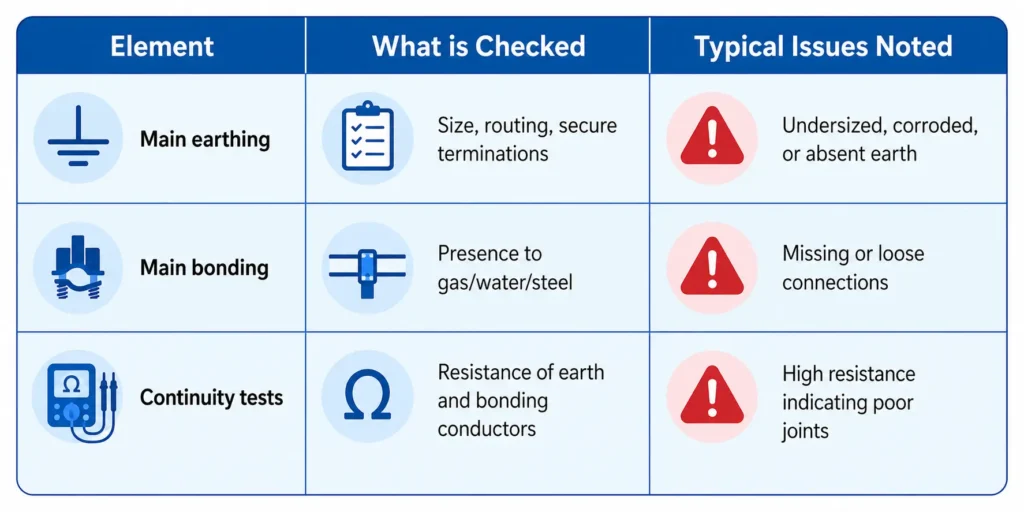
Attention then turns to the earthing and bonding, which underpin the safe operation of every circuit in an old London flat. The inspector confirms that the earthing conductor is present, continuous, and correctly sized from the supply intake to the consumer unit. They also check that fault paths are low-resistance, allowing protective devices to disconnect quickly during a fault.
Proper bonding is then reviewed at key services: incoming water, gas, and any structural steel. Bonding conductors must be secure, labelled where possible, and connected on the consumer’s side of any meters or stopcocks.
Check Electrical Alterations in Converted Flats
In older London townhouses converted into separate dwellings, the pattern and quality of electrical alterations often determine whether an EICR passes without significant observations. An inspector assesses how the original wiring has been modified to create flats, maisonettes, or bedsits, and whether those changes respect modern safety standards and load demands.
Typical focus areas include:
- Historic conversions – Were new circuits added or simply extended from a shared, older installation?
- Load distribution – Are consumer units and circuits correctly sized for added kitchens, showers, and heaters?
- Segregation of supplies – Does each flat have clearly defined, separately protected circuits and metering?
- Documentation – Are previous alteration certificates, drawings, or labels available to confirm what was changed and when?
Check Sockets, Switches and Fixed Accessories
Inspecting sockets, switches and other fixed accessories during an EICR on an old London flat reveals many of the day‑to‑day safety risks occupants actually touch. The inspector first confirms that enough socket outlets are provided for typical use, reducing the temptation to rely on multi‑way adaptors and trailing leads. They note the location of accessories relative to sinks, cookers and baths, checking that appropriate distances and protection are maintained.
They then verify that accessories are correctly installed and securely fixed, with no gaps that could expose internal parts. Tests confirm that socket circuits are correctly wired for polarity and have effective earthing, ensuring that metal‑faced accessories and connected equipment remain safe if a fault occurs, especially in properties with mixed‑age wiring.
Look for Signs of Overheating or Damage
Beyond confirming that sockets and switches are correctly installed and wired, an EICR on an old London flat also focuses on physical evidence of stress, overheating and impact damage. The inspector looks for subtle indicators that circuits have been overloaded or improperly altered over time.
Typical checks include:
- Discolouration or brown scorch marks around sockets, switches, or light fittings, suggesting excessive heat or loose terminations.
- Melted, brittle or cracked plastic on accessories, consumer unit covers, or lampholders, indicating dangerous temperatures.
- Acrid or “fishy” odours near outlets, especially under load, which can reveal deteriorating insulation or overheating contacts.
- Stiff, cracked or frayed cable sheathing, particularly near junction boxes, immersion heaters, or older ceiling roses, signalling age‑related degradation and potential fire risk.
Review Previous EICR Reports and Repairs
Reviewing previous EICR reports and records of electrical repairs allows the inspector to build a clear picture of how the installation has evolved and where recurring issues may lie. For older London flats and maisonettes, this historic trail is often essential, because wiring is frequently layered over several refurbishments, conversions, and partial upgrades.
The inspector can compare earlier codes, recommendations, and test results with the current condition, checking whether defects were actually rectified and if any “temporary” fixes became permanent. Patterns such as repeated tripping on a particular circuit, ongoing bonding concerns, or recurring overheating at the same accessories may reveal deeper faults. Documentation also helps identify past contractor competence and clarifies which parts of the system are original, modified, or recently replaced.
Arrange a Qualified EICR Electrician
Securing a properly qualified electrician is critical to a reliable EICR, especially in aging London flats where hidden defects are common. The choice of contractor directly affects the accuracy of the report and the practicality of any recommendations, so selection should be deliberate rather than rushed or purely cost-driven.
Owners and landlords typically work through four key checks:
- Competence – Confirm they are approved by NICEIC, NAPIT, or another UKAS‑accredited body and experienced with older London stock.
- Insurance – Verify public liability and professional indemnity cover, with proof on request.
- Scope and price – Obtain a written quotation clearly stating EICR scope, limitations, and VAT.
- Reporting standards – Ask for a sample EICR to review clarity of coding, observations, and schedules.
Actions After an Unsatisfactory EICR
Once an EICR is marked as unsatisfactory, the priority shifts from assessment to targeted remediation, guided by the specific C1, C2, and FI codes listed in the report. The landlord or owner should first address any C1 items immediately, as these indicate present danger; this can mean isolating circuits or stopping use until repaired.
C2 items, which signal potentially dangerous defects, must be rectified within a prompt, documented timeframe, often before new tenants move in or contracts are renewed. FI codes require further investigation, usually by the same or another qualified electrician, to clarify hidden risks.
After remedial works, the electrician should provide written certification or a new EICR demonstrating that the installation now meets current safety standards. Know about EICR codes in detail.
Frequently Asked Questions
Can I Stay in the Flat While the EICR Inspection Is Carried Out?
Yes, they can usually stay in the flat during an EICR, provided electricians have clear access to sockets, consumer units, and wiring routes. Power may be temporarily switched off in circuits, so planning for brief interruptions is sensible.
How Much Notice Must I Give Tenants Before an EICR Inspection?
They should usually give at least 24 hours’ written notice, though 48 hours is considered best practice. The tenancy agreement may specify longer. Notice must explain purpose, date, time window, and respect tenants’ reasonable availability. Read our blog post Tenant Access Checklist: EICR Tenant Access Checklist for EICR Inspections.
Does an EICR Report Affect My Building or Contents Insurance?
An EICR can influence building and contents insurance, as many insurers require a satisfactory, in‑date report. If the report is missing or highlights unresolved serious defects, insurers may refuse cover, limit claims, or increase premiums.
How Often Should Communal Areas in Converted London Blocks Be Tested?
Communal areas in converted London blocks are typically tested every five years. However, a competent electrician may recommend shorter intervals if higher risk exists, heavy use is evident, or previous Electrical Installation Condition Reports reveal recurring issues.
Can I Use One EICR for Multiple Flats in the Same Building?
No, one EICR cannot normally cover multiple self‑contained flats. Each flat is a separate electrical installation requiring its own report, while communal areas usually need a distinct EICR for shared circuits, services and landlord’s supplies.
Conclusion
In older London flats, conversions and maisonettes, a thorough EICR is essential rather than optional. By ensuring full access, checking wiring age, inspecting the consumer unit, and confirming correct earthing and bonding, landlords and owners can uncover hidden risks before they become serious hazards. Reviewing past reports and using a qualified electrician helps maintain consistency and compliance. When faults are found, acting quickly on remedial work protects residents, property value, and legal standing.