
Everyone should know how long to allow for EICR inspection. Most landlords should allow around 1–3 hours for an EICR inspection in a rented flat and 2–4 hours or more for a rented house. Smaller studios tend to be quicker, while large or older properties, or those with many circuits, can push inspection times higher. Power is usually off in short stages rather than the whole time. Planning for these typical timeframes helps owners and tenants know what to expect and what can influence the duration further.
Key Takeaways
- Allow around 1–3 hours for most rental flats; compact studios are quicker, while larger or older flats sit near the upper end.
- Expect 2–4+ hours for rented houses, with larger or multi-storey properties sometimes taking 4–6 hours or more.
- More circuits and complex consumer units significantly extend inspection time, as each circuit must be individually isolated and tested.
- Older properties with mixed wiring, alterations or DIY work usually need longer inspections to trace circuits and check historical changes.
- Reports are typically issued within 24–72 hours after the visit, but larger or complex properties may take up to five working days.
Table of Contents
Average EICR Inspection Time for a Rental Flat
For a typical rental flat, an Electrical Installation Condition Report (EICR) inspection usually takes between 1 and 3 hours, depending on the size of the property and the complexity of its wiring.
A compact studio with a modern consumer unit and minimal circuits will generally sit at the shorter end of this range, allowing occupants to get back to normal quickly. Larger multi‑bedroom flats, or those with older or altered wiring, tend toward the upper limit, as more circuits and accessories must be tested.
Time is also shaped by how easily the electrician can move around the flat. Clear access to the consumer unit, sockets, and fixed appliances reduces disruptions and keeps the inspection focused and efficient.

Average EICR Inspection Time for a Rented House
Although the basic testing principles are the same as in a flat, an EICR inspection in a rented house typically takes longer, often ranging from 2 to 4 hours. This timeframe reflects the greater number of circuits and accessories usually found in a house, along with additional fixed equipment such as cookers, showers, or outdoor supplies.
An electrician will need time to isolate power safely, remove a sample of accessories, test circuits methodically, and record results without rushing. Occupants who value flexibility often choose a half‑day window, keeping the rest of their schedule free. Clear access to the consumer unit, sockets, and switches helps prevent delays, allowing the inspection to be completed efficiently while still delivering a thorough, independent safety assessment. Understand the EICR inspection checklist: EICR inspection checklist for London landlords before the electrician arrives.
How Property Size Changes the Inspection Duration
When considering how long an EICR will take, the physical size of the property is one of the most significant factors influencing duration. A compact flat allows the electrician to move quickly and methodically, while a large multi‑storey house demands more time simply to access, test, and document every area. Hallways, outbuildings, and hidden corners all add minutes that can accumulate into hours.
A rough guide is:
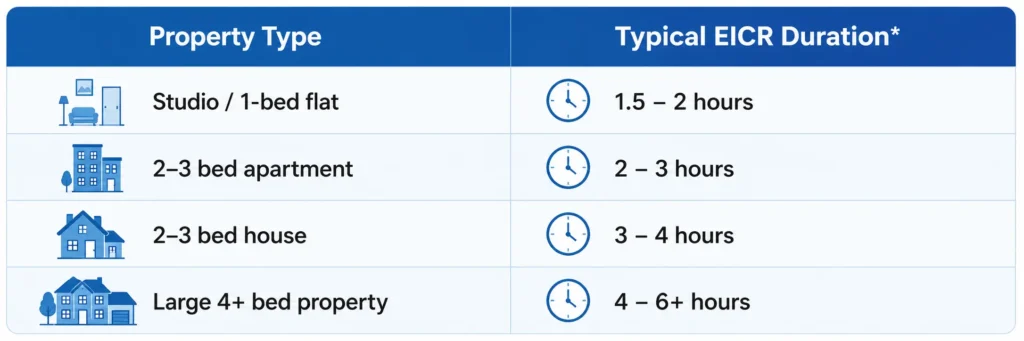
Actual times vary with layout, access, and previous alterations.
Number of Electrical Circuits Affects Inspection Time
Beyond the physical size of the property, the number of electrical circuits has a direct and often greater impact on EICR inspection time. Each circuit must be isolated, tested, and documented, so a consumer unit packed with multiple lighting, socket, heating, and appliance circuits inevitably takes longer to assess than a simple board with only a few ways.
For landlords who value flexibility and minimal disruption, understanding this relationship is essential. A studio flat with many dedicated circuits for underfloor heating, ovens, and EV charging can demand more time than a larger but more simply wired home. More circuits mean more test points, more records, and more potential faults to trace, all of which extend the overall inspection duration.
Why Older Rental Properties May Need More Time
Older rental properties generally require longer EICR inspections because their electrical systems often reflect multiple generations of additions, alterations, and repairs. Circuits may have been extended, adapted, or partially upgraded over time, sometimes with limited documentation. This layered history makes it harder for the inspector to trace what feeds what, verify protective devices, and confirm everything still works together safely.
Older consumer units, rewirable fuses, and mixed cable types often demand closer examination and more testing. Earthing and bonding arrangements may also fall short of current expectations, requiring extra investigation. Hidden junction boxes, buried cables, and improvised DIY work can slow progress further. Allowing extra time here ultimately protects both landlord and tenant, preserving flexibility without compromising safety.
How Long the Electrician Needs Inside the Property
For most rental homes, the electrician typically needs uninterrupted access to the property for anywhere between two and four hours to complete an EICR. This window gives enough time to test circuits, inspect the consumer unit, and check accessible sockets, switches, and fixed wiring without rushing, helping avoid unnecessary repeat visits or extra disruption.
The exact time inside depends on how many circuits there are, how spread out the rooms are, and how clear access is to the fuse board and outlets. A compact one‑bed flat with straightforward wiring may be completed faster, while a large, multi‑storey house, or a property with several extensions, usually takes longer. Allowing a generous slot helps guarantee thorough testing and fewer constraints on everyone’s day.
Will the Tenant Need to Stay During the EICR Inspection?
Often the tenant does not need to stay in the property for the full duration of an EICR, provided the electrician has clear access and any necessary keys or codes. Many tenants prefer this, as it allows them to continue their day without being tied to the appointment.
Whether presence is required usually comes down to access and the landlord’s or agent’s procedures. If all rooms, consumer units, and fixed equipment are reachable, and any alarms or security systems are managed, the visit can often go ahead without the tenant. Some tenants may still choose to be present for peace of mind, to safeguard belongings, or to answer practical questions about past electrical issues, but this is usually optional rather than compulsory.
How Long the Power May Be Switched Off During Testing
Whether the tenant stays or leaves, one of the most practical concerns during an EICR is how long the electricity will be turned off. In most rented homes, power is interrupted in short stages while each circuit is tested, rather than being cut for the whole visit. A typical circuit may be off for 20–40 minutes, with occasional full shutdowns of 10–30 minutes when the consumer unit is tested.
To plan daily life with minimal disruption, tenants may wish to note:
- Whether critical appliances (fridges, medical equipment) need backup or notice
- Which rooms or circuits will be isolated first
- Approximate windows for any full power shutdowns
- When testing is likely to finish so normal routines can resume freely
How Landlords Can Help Reduce EICR Inspection Time
Clear preparation by the landlord can greatly shorten the duration of an EICR inspection and minimise disruption for tenants. By planning ahead, a landlord allows the electrician to move freely, test efficiently, and finish sooner, giving tenants faster access back to their usual routines.
Landlords can confirm access to all rooms, guarantee keys work, and notify tenants of the exact inspection window. Clearing areas around the consumer unit, sockets, and fixed appliances avoids time‑consuming obstruction issues. Providing basic circuit information, previous reports, and records of alterations further streamlines testing. Learn about EICR inspection day preparation: Landlord preparation guide.
| Landlord action | Time‑saving benefit |
| Guarantee full property access | Prevents delays and revisits |
| Clear access to electrical points | Speeds up testing and visual checks |
| Provide install/alteration records | Reduces investigative time for electrician |

How Long After the Inspection Will You Receive the EICR Report?
With the inspection complete and disruption kept to a minimum through good preparation, attention naturally turns to how quickly the written EICR will arrive. In most straightforward cases, electricians issue the report within 24–72 hours, once test readings are checked and observations confirmed. Larger or more complex properties can stretch this to five working days, especially where further analysis or photos must be reviewed.
Landlords who value flexibility and minimal constraint tend to confirm timescales upfront and choose contractors who commit to clear turnaround targets.
Typical variables include:
- Volume of circuits and distribution boards
- Complexity of defects requiring extra evaluation
- Electrician’s workload and admin processes
- Whether urgent remedial quotes are requested alongside the report
If you want to know about EICR ratings in the UK, check out EICR codes which describe the inspection results.
Frequently Asked Questions
How Often Do Rental Properties Legally Need an EICR Inspection?
Rental properties generally need an EICR at least every five years, or sooner if the report specifies. This legal rhythm balances safety with autonomy, ensuring electrics stay compliant while landlords and tenants maintain flexible control over their space.
What Happens if an EICR Identifies C1, C2 or FI Faults?
If an EICR flags C1, C2 or FI, the electrician must recommend urgent or immediate remedial work. The landlord then faces legal pressure to fix hazards quickly, or risk enforcement, penalties, and tenant safety concerns.
Who Is Responsible for Arranging and Paying for the EICR in Rentals?
The landlord normally arranges and pays for the EICR, as legal duty-holder for electrical safety. Tenants retain freedom to request evidence, challenge unsafe conditions, and refuse access only on reasonable grounds, though cooperation usually protects everyone’s rights and safety.
Can a Landlord Use Any Qualified Electrician for an EICR?
Yes, a landlord may use any suitably qualified electrician, but they must be competent to carry out EICRs, usually registered with a recognised scheme. Choosing accredited inspectors protects tenants’ safety, legal compliance and the landlord’s long‑term freedom from disputes.
What Penalties Can Landlords Face for Not Having a Valid EICR?
Landlords risk civil penalties up to £30,000 per breach, enforced remedial notices, potential rent repayment, difficulty evicting tenants, invalidated insurance, and exposure to negligence claims if electrical faults cause injury, damage, or death due to missing or invalid EICRs.
Conclusion
While concluding “how long to allow for EICR inspection”, the time needed for an EICR in a rented property depends mainly on size, number of circuits, and the condition and age of the installation. Landlords can shorten visits by ensuring clear access and good tenant communication, while tenants rarely need to stay for the full duration. Although power will be off intermittently, disruption is usually manageable, and in most cases the written EICR report follows within a few days of the inspection.