
An EICR renewal checklist in the UK starts with confirming when the current report expires and noting the “Next Inspection Due” date. The user should review any previous C1, C2 or FI codes and confirm all remedial work is documented as complete. They should check the consumer unit and visible wiring for damage, gather past certificates and repair invoices, and notify tenants about access. They can then move on to understand the renewal visit and what happens after the report.
Key Takeaways
- Confirm your current EICR’s “Next Inspection Due” date and book renewal early to avoid any lapse in legal compliance, especially for rented properties.
- Review previous EICR codes (C1, C2, FI) and ensure all remedial works are completed, documented, and certificates or invoices are easily accessible.
- Prepare the property by clearing access to consumer units, sockets, lofts, basements, and any locked electrical areas, providing keys or access codes as needed.
- Notify tenants in writing with the inspection date, purpose, and access requirements, requesting they clear belongings from electrical points before the visit.
- After renewal, check the overall EICR outcome, prioritise and schedule fixes for any C1/C2/FI items, then file the report and note the next due date.
Table of Contents
When Is Your EICR Due for Renewal?
How can property owners be certain they are renewing their Electrical Installation Condition Report (EICR) on time? They first need a clear understanding of how often an EICR is typically required for their type of property and use. In the UK, renewal timing usually depends on factors such as whether the property is rented or owner‑occupied, its age, how it is used, and any history of electrical problems.
A landlord, for example, will usually face more frequent EICR renewals than an owner‑occupier, because tenants change and usage patterns vary. High‑demand or commercial environments often justify shorter intervals between inspections. By understanding these broad renewal drivers, a property owner can plan ahead, schedule inspections sensibly, and avoid last‑minute compliance pressure.

Check the Expiry Date on Your Current Report
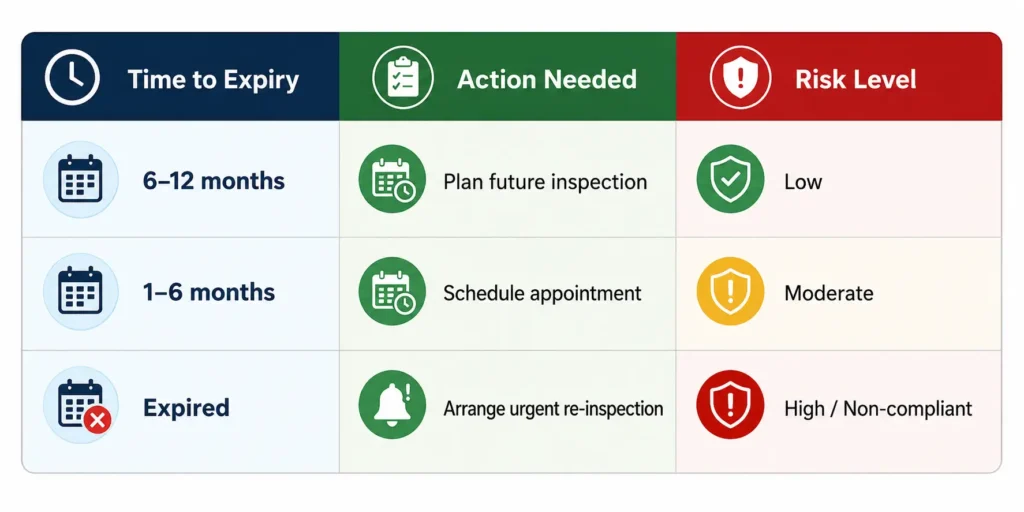
Before planning a new inspection, a property owner should first check the expiry date on the existing EICR. This date is normally found on the first page of the report, often near the “Next Inspection Due” or “Recommendation for Re-inspection” field. Confirming it helps guarantee the installation remains legally compliant and adequately insured.
If the EICR is close to expiry, booking early avoids gaps in certification, especially for rented properties. The table below summarises key timing points:
Review Any Previous C1, C2, C3 or FI Codes
Once the expiry date has been confirmed, attention should turn to any C1, C2, C3 or FI codes recorded on the existing EICR. These codes indicate how serious previously identified issues were and guide what should be prioritised before arranging a new inspection.
A C1 (Danger Present) means there was an immediate risk of electric shock or fire at the time of the last report. C2 (Potentially Dangerous) highlights defects that could become hazardous if left unaddressed. FI (Further Investigation) signals uncertainty, where the electrician could not fully assess a potential fault. Check in detail about EICR codes.
Confirm Remedial Work Was Completed
The next step is to verify that all remedial work identified in the previous EICR has been fully and correctly completed. A responsible person should gather all invoices, completion reports, and Electrical Installation Certificates (EIC) or Minor Works Certificates issued by the electrician who carried out the repairs.
They should then compare these documents against the original C1, C2, and FI items, confirming that each defect or query has a corresponding piece of evidence showing what was done, where, and when. If anything is unclear, they should request clarification or additional documentation from the contractor. Recording this verification in a simple log or summary helps demonstrate due diligence and provides a clear trail for the next EICR assessment.
Check the Consumer Unit Condition
A central part of any EICR renewal is a focused inspection of the consumer unit, as this is where circuits are controlled and protective devices are housed. The inspector first assesses the overall condition of the enclosure, checking it is securely fixed, undamaged, and made of suitable material, often metal for fire resistance. Clear, accurate labelling of circuits is verified so that each breaker or fuse can be easily identified.
They then review the presence and correct operation of main switches, RCDs, and MCBs, confirming they match the installation’s requirements and show no signs of overheating or mechanical damage. Adequate access, safe isolation arrangements, and proper cable entry and glanding are also examined to guarantee the consumer unit remains safe and compliant.
Inspect Sockets, Switches and Visible Wiring
Inspecting sockets, switches, and visible wiring forms a critical part of an EICR renewal, as these components are subject to frequent use and wear. During an inspection, the electrician will methodically check each outlet and switch plate to verify it is securely fixed, correctly aligned, and suitable for the circuit it serves. They confirm that accessories are appropriate for their location, such as in kitchens or other special installation areas.
Visible wiring is reviewed to ascertain it is properly contained in trunking, conduit, or suitable cable routes, and that cables are adequately supported and protected from physical impact. The inspector also considers whether any extensions, alterations, or DIY additions appear to comply with current regulations and good installation practice.
Look for Signs of Damage or Overheating
Many potential electrical faults first reveal themselves as subtle signs of damage or overheating, so an EICR renewal includes a focused visual check for these indicators. An electrician will typically begin at the consumer unit, looking for scorch marks, discoloured plastic, or a burnt smell around breakers and main switches. Such clues suggest loose connections or overloaded circuits.
They also examine accessible cable runs, junction boxes, and terminations for brittle insulation, cracking, green deposits on copper, or visible melting. Any brown or yellow staining around enclosures can indicate prolonged heat. Buzzing, sizzling, or intermittently warm covers are noted as warning signs. Where damage or overheating is suspected, the inspector records observations, may recommend immediate isolation, and schedules further testing or remedial work.
Check Lighting Points and Fixed Fittings
Lighting points and fixed fittings receive particular attention during an EICR renewal, as they combine electrical components with regular user interaction. The inspector examines ceiling roses, pendant fittings, downlights, wall lights, and batten holders for secure mounting, suitable support, and correct enclosure of live parts. Loose fittings or exposed conductors are noted as potential safety issues.
They also confirm that lamp holders are compatible with the lamps in use, especially where high-heat sources such as halogen or some LED retrofits are installed. Signs of overheating, discolouration, or brittle plastic are recorded. Bathroom and outdoor fittings are checked for appropriate IP ratings and corrosion. Finally, the inspector confirms that switches and dimmers linked to lighting points are correctly wired and firmly fixed.
Test Access to All Electrical Areas
Verifying access to all electrical areas is an essential step in any EICR renewal. Inspectors must be able to reach every part of the electrical installation to complete testing safely and accurately. This includes consumer units, distribution boards, fixed equipment supplies, and any outbuildings or external points. Limited access can cause gaps in the report, leading to unsatisfactory outcomes or the need for repeat visits.
To prepare effectively, the responsible person should confirm that:
- All consumer units and distribution boards can be safely opened
- Loft or basement electrical points are reachable with suitable access
- External sockets and supplies are not secured or blocked
- Dedicated electrical cupboards are accessible and clearly identified
- Keys or access codes for restricted areas are available on inspection day
Remove Obstructions Around Electrical Points
Clearing obstructions from around electrical points is essential to confirm inspectors can safely access and test each circuit during an EICR renewal. Furniture, stored boxes, appliances, and decorative items should be moved away from sockets, switches, fuse spurs, consumer units, and fixed equipment before the inspection begins.
The responsible person should create clear space around each point, typically at least arm’s length, so testers can remove faceplates, use test instruments, and visually examine cables and terminations. Special attention should be given to areas behind large appliances, under worktops, and in built-in cupboards where outlets are often hidden. Removing obstructions reduces the risk of accidental damage, prevents delays, and confirms the inspection reflects the true condition of the installation.
Gather Previous Electrical Safety Records
A crucial step before an EICR renewal is assembling all existing electrical safety documentation so the inspector can review the installation’s history. Having a clear record helps identify recurring faults, confirm previous remedial work, and check whether earlier recommendations have been followed. It can also prevent unnecessary duplication of tests, saving time and cost.
Owners or managers should locate and organise key documents, ideally in one folder (digital or paper) that can be handed to the electrician on arrival.
Useful records include:
- Previous EICR reports and certificates
- Minor Electrical Installation Works Certificates
- Electrical Installation Certificates from any major rewiring or new circuits
- Invoices or reports from electricians detailing repairs or upgrades
- Product documentation or warranties for consumer units and key equipment
Tell Tenants About the Renewal Visit
Before an EICR renewal takes place, landlords or managing agents should inform tenants well in advance so access can be arranged smoothly and legally. Written notice is usually best, as it provides clear evidence that tenants have been told the date, approximate time window, and purpose of the visit.
The communication should state that the inspection is a legal safety requirement, not optional work, and reassure tenants that disruption will be kept to a minimum. It is helpful to confirm which rooms or areas need to be accessible and remind tenants to move belongings away from sockets and consumer units where possible.
Landlords should also provide contact details so tenants can raise concerns or request reasonable adjustments.

What Happens After the New Report Is Issued
Once the renewed EICR is issued, attention shifts from inspection to action. The duty holder reviews the outcome: “Satisfactory” usually means only routine maintenance, while “Unsatisfactory” requires remedial work within specified timeframes. Each observation is coded (C1, C2, C3, FI) and should be matched with a clear plan.
| Step / Focus Area | Purpose / Outcome |
| Review overall result | Confirm whether the installation is compliant |
| Examine each observation | Understand risks and required corrective actions |
| Prioritise C1 and C2 items | Address immediate and potentially dangerous defects |
| Appoint qualified electrician | Arrange and document remedial works |
| File and schedule renewal | Keep records and note the next EICR due date |
After works, updated documentation or a new EICR confirms compliance.
Frequently Asked Questions
How Much Does an EICR Renewal Typically Cost for a UK Rental Property?
It typically costs £100–£250 for an EICR renewal on a UK rental, depending on property size, region, and electrician. Larger or more complex installations cost more, and remedial work, if required, is always charged separately.
Who Is Qualified to Carry Out an EICR Renewal in the UK?
An EICR renewal in the UK must be carried out by a qualified, competent electrician, typically registered with a recognised scheme such as NICEIC, NAPIT, or STROMA, holding appropriate inspection, testing, and current wiring regulations qualifications.
How Long Does an EICR Renewal Inspection Usually Take?
An EICR renewal inspection usually takes between 2 and 4 hours for a typical three-bedroom home. Time varies with property size, circuit complexity, accessibility of equipment, and whether remedial issues or previous defects need extra investigation.
Do I Need an EICR Renewal if I’M Selling, Not Renting, My Property?
They are not legally required to get an EICR when selling, only when renting. However, buyers or solicitors often request one, so obtaining a recent EICR can reassure buyers, speed conveyancing, and support the asking price.
Can I Stay in the Property While the EICR Renewal Is Being Done?
Yes, they can usually remain in the property during an EICR renewal. The electrician may briefly switch off power to circuits, causing temporary disruption to lighting, sockets, or appliances, but safety and access requirements are carefully managed.
Conclusion
By following an organised EICR renewal checklist, a landlord or property owner can approach each inspection with confidence and clarity. Checking expiry dates, confirming past remedial work, and preparing tenants and paperwork in advance helps prevent last‑minute issues. Understanding what happens during and after the assessment also makes it easier to act quickly on any C1, C2, or FI findings, ensuring the electrical installation remains safe, compliant and ready for continued occupation.