
To check if an electrician is suitable for an EICR in the UK, a person should confirm formal inspection and testing qualifications (e.g. City & Guilds 2391), up‑to‑date BS 7671 knowledge, and recent EICR experience on similar properties. They should verify registration with a Competent Person Scheme (NICEIC, NAPIT), ask for proof of insurance, and review sample reports and customer feedback. Recognising key warning signs and essential questions will help them choose more confidently.
Key Takeaways
- Confirm they hold up-to-date inspection and testing qualifications (e.g., City & Guilds 2391) and can show certificates, not just claim them.
- Check they’re registered with a recognised Competent Person Scheme (e.g., NICEIC, NAPIT) and have valid public liability insurance.
- Ask how many EICRs they’ve completed recently, on similar properties, and request anonymised sample reports to review clarity and detail.
- Ensure they follow BS 7671 defect coding (C1, C2, C3, FI), can explain each code, and don’t invent their own categories.
- Look for clear written quotations, willingness to explain findings, proper test equipment, good reviews, and no reluctance to share credentials or paperwork.
Table of Contents
Why the Right EICR Electrician Matters
Choosing the right EICR electrician is critical because the accuracy of an Electrical Installation Condition Report directly affects safety, compliance, and future costs. An EICR is not just a formality; it is the basis on which landlords, homeowners, and businesses decide whether an installation is safe to use or needs corrective work.
A competent electrician identifies genuine risks, such as fire and electric shock hazards, instead of overlooking defects or flagging harmless issues. Their judgement influences whether circuits are condemned unnecessarily or left dangerously in service. Insurers, letting agents, and local authorities often rely on the report’s findings. As a result, choosing an electrician who understands current UK wiring regulations and applies them correctly protects occupants, property, and long‑term budgets. Check out the details of EICR: Essential Guide for UK Homeowners and Landlords.

Check Their Inspection and Testing Qualifications
Because so much rests on the accuracy of an EICR, the first check on any electrician should be their formal inspection and testing qualifications. In the UK, this usually means a City & Guilds qualification specifically covering inspection and testing, such as 2391 or its updated equivalents (e.g., 2391-52).
The homeowner or landlord should ask to see certificates, not just take verbal assurances. They can also look for a current qualification date, showing the electrician has trained under recent wiring regulations.
An electrician may be fully qualified for general electrical work yet lack dedicated inspection-and-testing training. Ensuring they hold the correct, named qualifications helps confirm they understand fault-finding, test instruments, and the legal standards behind a compliant EICR. Explore more about EICR Inspection: EICR Inspection Checklist for London Landlords Before the Electrician Arrives.
Confirm Their EICR Experience
Beyond formal qualifications, a landlord or homeowner should verify that the electrician has substantial, recent experience specifically in carrying out EICRs. Not every qualified electrician regularly performs full inspection and condition reporting, and inexperience can lead to missed defects or over‑cautious coding that triggers unnecessary remedial work.
To gauge genuine EICR experience, a client can:
- Ask how many EICRs the electrician has completed in the last 12–24 months.
- Check whether this experience is mainly in similar properties (age, size, domestic or commercial).
- Request sample, anonymised EICR reports to see the level of detail and clarity.
- Ask how they stay current with BS 7671 amendments and EICR coding guidance.
- Enquire about typical issues they find and how they explain them to non‑experts.
Use a Registered Electrician Search Tool
While personal recommendations are useful, a landlord or homeowner can quickly narrow down competent EICR providers by using official registered electrician search tools. These online tools allow users to enter a postcode and filter for electricians who indicate EICR or inspection and testing as a service.
A careful user will read each listing rather than just picking the nearest contractor. They can check how long the business has been established, whether it focuses mainly on inspection work, and whether it serves domestic, commercial, or both property types.
Many tools also include contact details and links to websites, letting someone compare several electricians in one session, request sample reports, and verify that the contractor regularly undertakes EICR work on similar properties.
Check Competent Person Scheme Registration
In addition to using search tools, a landlord or homeowner should confirm that any EICR contractor is registered with a recognised Competent Person Scheme (CPS). CPS membership indicates that the electrician has been vetted for qualifications, insurance, and ongoing competence, and can self-certify certain notifiable work.
They should:
- Check for logos such as NICEIC, NAPIT, ELECSA, or STROMA on quotes, websites, and vehicles
- Use the relevant scheme’s online “find a contractor” tool to verify the electrician’s name and trading details
- Confirm that the registration is current and covers domestic installation work
- Ask for the electrician’s CPS registration number and cross‑check it independently
- Keep screenshots or copies of CPS evidence with EICR documentation for future reference
Ask About BS 7671 Knowledge
How can a landlord or homeowner be confident that an electrician truly understands the Wiring Regulations that underpin an EICR? They can start by asking which edition of BS 7671 the electrician works to and whether they are familiar with the latest Amendment. An informed electrician should immediately reference BS 7671:2018 (as amended) and explain that EICRs must follow its requirements.
They might also be asked to outline what “departures” or “C1, C2, C3” observations mean under BS 7671. Clear, confident explanations show practical understanding, not just exam memorisation. Requesting evidence of recent BS 7671 update training, such as 18th Edition or amendment-specific courses, further confirms current knowledge and helps distinguish genuinely competent EICR inspectors from those whose knowledge is outdated.
Confirm They Understand Landlord Duties
Beyond technical knowledge of BS 7671, a competent EICR inspector should also show clear understanding of a landlord’s legal responsibilities for electrical safety. They should be able to explain how the Electrical Safety Standards in the Private Rented Sector (England) Regulations 2020 and similar rules elsewhere in the UK apply in practice.
A suitable electrician will clearly outline:
- How often fixed wiring in rented property must be inspected and tested
- What must appear on the written EICR report and who should receive copies
- Landlord duties for acting on C1, C2 and FI codes within defined timescales
- How to evidence compliance to letting agents, insurers and local authorities
- Consequences of non‑compliance, including enforcement powers and penalties
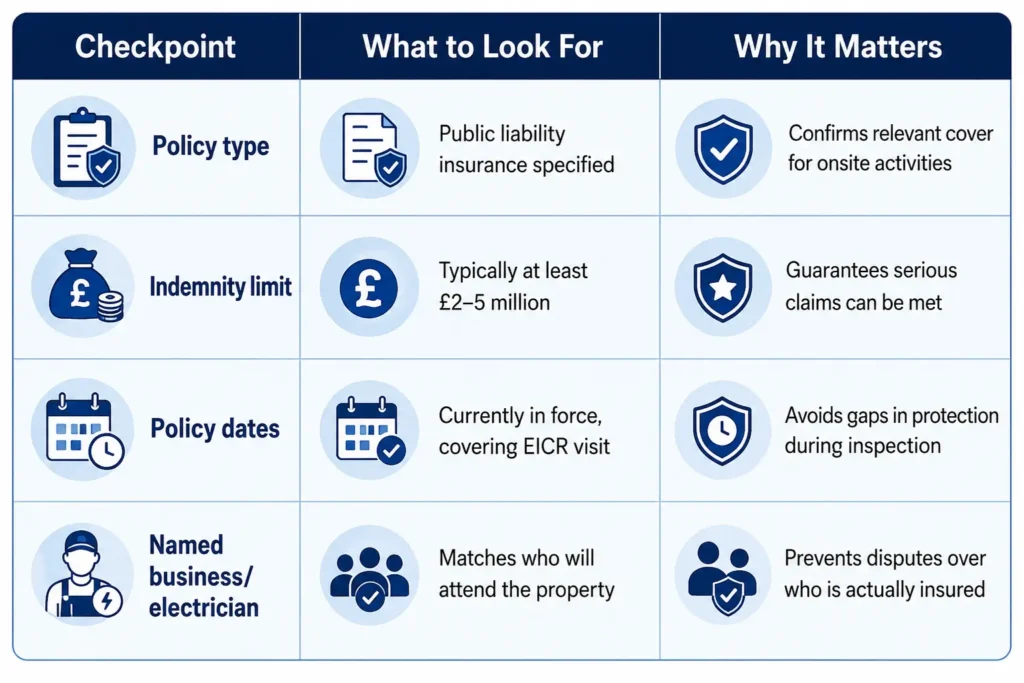
Check Their Public Liability Insurance
Adequately insured electricians reduce the financial risk to landlords if something goes wrong during an inspection or subsequent remedial work. Public liability insurance protects against damage to the property and injury to occupants caused by the electrician’s actions or equipment. Landlords should not rely on verbal assurances; they should ask to see proof of insurance.
Key points to verify are shown below:
Ask What the EICR Quote Includes
Before accepting an EICR quote, a landlord should clarify exactly what is included in the price. Different electricians structure quotes differently, and unclear terms can lead to unexpected extras. A detailed, written breakdown helps the landlord compare quotes fairly and avoid disputes once the inspection begins.
Points commonly needing clarification include:
- What areas and circuits of the property are covered in the inspection
- Whether remedial work is included or quoted separately
- If minor repairs, such as changing fuses or accessories, are included
- Whether the cost covers certification and providing the written EICR document
- Any additional charges, such as parking, travel, or urgent-visit fees
Review a Sample EICR Report
A sample EICR report allows a landlord to see exactly what to expect from the electrician’s documentation and how clearly they present their findings. By asking to view a previous, anonymised report, a landlord can judge whether the layout is logical, the language is plain, and the results are easy to follow.
The sample should clearly list circuits, test results, and observations in a structured format. Dates, test instruments used, and the electrician’s qualification details should be visible. Any limitations to testing should be clearly stated rather than hidden. Guidance on the overall outcome—satisfactory or unsatisfactory—should be unambiguous. A well‑presented sample report indicates that the electrician treats compliance, record‑keeping, and client communication seriously, making it easier for landlords to understand their property’s electrical condition.
Check How They Code Electrical Defects
Once a landlord is satisfied that an electrician’s reports are clearly presented, the next step is to look at how they code electrical defects. Each observation in an EICR should be given a clear code (C1, C2, C3, or FI) that matches recognised UK guidance. A competent electrician will explain what each code means in practical terms, not just technical jargon.
Landlords can quickly test an electrician’s approach by asking how they decide between C2 and C3 on borderline issues, or when they use FI instead of giving a definite code.
Key points to look for include:
- Consistent use of BS 7671 coding guidance
- Written definitions of each code
- Examples of typical C1, C2, C3, FI items
- Avoidance of “invented” codes
- Clear distinction between safety defects and improvement advice
Ask How They Handle Urgent Faults
How an electrician responds to urgent faults can reveal more about their professionalism than the report itself. When discussing an EICR, a careful client will ask what happens if a dangerous defect is discovered, such as exposed live parts or overheating cables. A competent electrician should clearly explain their process: how they make the installation safe immediately, what temporary measures they can apply, and when a full repair will follow.
They should also explain how they prioritise C1 and serious C2 faults, what hours they are available for emergencies, and how quickly they can usually attend. Clear information about costs for urgent call‑outs, and whether they will isolate only the affected circuits or the whole property, helps the client judge reliability and practicality.
Check Reviews Before Booking
Beyond understanding an electrician’s approach to urgent faults, clients benefit from checking independent reviews before agreeing to an EICR. Reviews help them see how the electrician performs in real homes, not just on paper. Balanced feedback, especially on specialist sites or trade platforms, can reveal patterns in punctuality, clarity of explanations, and respect for the property.
Readers may wish to look for:
- Comments about how clearly the electrician explained EICR findings
- Feedback on whether reports were delivered on time and in usable form
- References to professionalism, such as tidiness and courtesy on site
- Mentions of how additional work or costs were discussed and agreed
- Consistent themes across multiple platforms, not just one review site
Warning Signs of an Unsuitable Electrician
Sometimes the clearest way to choose the right EICR electrician is to spot the wrong one. Warning signs often appear early. A concerning indicator is reluctance to share basic credentials, such as registration with NICEIC, NAPIT, or another UK competent person scheme. If an electrician avoids written quotations, relies on vague estimates, or pressures for immediate decisions, this may suggest poor professionalism.
Another warning sign is dismissive behaviour about regulations, such as minimising the importance of BS 7671 standards or EICR reporting requirements. Turning up without appropriate test instruments, or appearing unsure how to use them, is also problematic. Finally, an electrician who seems rushed, unwilling to explain what an EICR involves, or keen to “pass everything” without proper testing should be treated with caution.
Questions to Ask Before Hiring
Before committing to an EICR inspection, a property owner benefits from asking structured, targeted questions that reveal an electrician’s competence and reliability. Focused queries help distinguish a genuinely qualified professional from someone merely claiming experience. Key points include formal credentials, specific EICR background, reporting standards, and transparency over pricing and timing.
Essential questions might include:
- What qualifications and registration do you hold (e.g., NICEIC, NAPIT, STROMA)?
- How many EICRs have you completed on similar properties in the last year?
- What will your EICR report include, and can I see a sample?
- How long will the inspection take, and will power need to be switched off?
- What is included in your quoted price, and are there any potential extra charges?
Frequently Asked Questions
How Often Should I Renew an EICR for My Rental Property?
They should renew an EICR for a rental property at least every five years, or sooner if the report recommends it. Landlords also need a new EICR at change of tenancy or after major electrical alterations.
Can I Use the Same Electrician for Repairs and the EICR?
Yes, they can usually use the same electrician, provided the contractor is properly qualified, insured, and independent in judgment, clearly documenting findings. Many landlords also prefer a separate inspector for complex cases to avoid any perceived conflict of interest.
Is an EICR Required When Buying or Selling a House?
An EICR is not legally required for standard UK home sales, but many buyers, lenders, and solicitors strongly recommend it. It provides documented evidence of electrical safety, supports negotiations, and can highlight issues before contracts are exchanged.
Who Is Responsible for Arranging the EICR in Shared Accommodation?
In shared accommodation, the landlord or managing agent normally arranges the EICR. They must guarantee inspections occur at least every five years, hire a qualified electrician, keep written reports, and provide copies to existing or prospective tenants on request.
What Happens if My Tenant Refuses Access for the EICR Visit?
If a tenant refuses access, the landlord should document all attempts, write formally explaining legal duties, offer flexible appointments, and, if refusal continues, seek legal advice or court access, showing they took all reasonable steps to arrange the EICR.
Conclusion
Choosing the right electrician for an EICR is essential for safety, compliance and avoiding costly surprises. By checking qualifications, proven inspection experience, and registration with a recognised competent person scheme, homeowners can be more confident in the report’s quality. Using search tools, reviewing feedback, and asking how urgent faults are handled further reduces risk. Staying alert to warning signs and asking clear questions before hiring helps guarantee a thorough, reliable and legally compliant EICR.