
An EICR report checklist in the UK should include property and client details, the purpose and scope of the inspection, and information on the age and visible condition of the electrical installation. It must record test results for each circuit, observations with C1, C2, C3 or FI codes, and note any testing limitations. The electrician’s details, signature, and a clear overall outcome (satisfactory or unsatisfactory) are essential, along with recommended remedial actions that are explained further next.
Key Takeaways
- Clearly identify the property, client details, inspection date, and purpose of the EICR (e.g. landlord compliance, periodic inspection, change of tenancy).
- Include an overall safety summary, stating if the installation is Satisfactory or Unsatisfactory, with reference to relevant BS 7671 regulations.
- Provide full circuit details and test results for each circuit, including protective devices, conductor sizes, continuity, insulation resistance, polarity, and fault-loop measurements.
- List all observations with precise locations and classification codes (C1, C2, C3, FI), highlighting non-compliance, damage, wear, overheating, or safety risks.
- Record installation age and visible condition, earthing and bonding arrangements, consumer unit condition, and any testing limitations or inaccessible areas affecting the inspection scope.
Table of Contents
Difference Between EICR Report and EICR Certificate
For many property owners, the terms “EICR report” and “EICR certificate” are used interchangeably, but they describe slightly different things. An EICR report is the full written outcome of a detailed inspection of a property’s fixed electrical installation. It records observations, test results, and whether the installation is satisfactory or requires remedial work.
An EICR certificate is the formal confirmation issued by a qualified electrician after that inspection, usually summarising compliance with current regulations. It is often the document requested by letting agents, insurers, and local authorities as proof that checks have been carried out. In practice, both documents serve the same goal: to show that a property’s electrics have been independently assessed for safety and ongoing freedom of use.

Property and Client Details
Clear identification of the property and client anchors the entire EICR report in context and accountability. This section records the full postal address, postcode, and any unique identifiers such as flat, unit, or plot numbers. Accurate details guarantee the report cannot be confused with any other premises, protecting both occupants and owners.
Client information sets out who commissioned the inspection and who holds decision‑making power. Typically, this includes the legal name, trading name if applicable, correspondence address, and contact details of the owner, landlord, managing agent, or authorised representative. Where the person granting access differs from the legal client, both are recorded. These specifics give clarity over responsibility, reduce disputes, and support swift action if remedial work is needed.
Purpose of the Electrical Inspection
Purpose frames the entire Electrical Installation Condition Report, defining exactly why the inspection has been commissioned and what it is intended to achieve. In this section, the inspector states whether the EICR is for a routine safety check, a change of tenancy, sale or purchase, licensing compliance, insurance requirements, or a landlord’s legal duty.
The purpose clarifies the scope of testing, the level of scrutiny, and the degree of risk the client is willing to tolerate while still protecting occupants’ safety and property. It also records whether the client seeks minimum legal compliance or a higher standard aligned with personal responsibility and independence. A clearly defined purpose guarantees the findings support informed choices, not unnecessary restrictions.
Installation Age and General Condition
Once the purpose of the inspection is established, attention turns to the age and general condition of the electrical installation, as these factors heavily influence risk and remedial priorities. An EICR should clearly record the approximate installation date, noting any later alterations that may not align with current standards or the occupier’s preferred way of using the space.
The inspector typically comments on wear, damage, and deterioration of wiring, accessories, and containment, as well as visible signs of overheating, corrosion, or mechanical stress. Protective devices, consumer units, and earthing and bonding arrangements are assessed for modernity, robustness, and clear labelling. This section of the report enables informed choices about upgrades, empowering the person responsible to remove constraints, add capacity, and use electricity more flexibly.
Extent and Limitations of Testing
Although an EICR aims to provide a thorough assessment, every report must define the exact extent of the inspection and any limitations that apply. This transparency lets owners understand what has been verified and what remains outside the inspector’s reach, so they can make informed, independent decisions about risk and future work.
An EICR should clearly record:
- Areas and circuits actually inspected, tested, or sampled
- Parts of the installation not accessed (locked rooms, concealed wiring, outbuildings)
- Tests that were restricted for safety, business continuity, or occupant refusal
- Assumptions made where visual evidence is limited or elements are hidden
Electrical Supply Characteristics
Before evaluating individual circuits and accessories, an EICR must first record the fundamental electrical supply characteristics feeding the installation. This establishes the real limits within which the system can safely operate and be altered in future without guesswork or dependence on a single contractor’s memory.
The report should identify supply type and number of phases, nominal voltage, and frequency, confirming compatibility with connected equipment. Prospective fault current and prospective short-circuit current at the origin must be measured or calculated, as these values govern breaker ratings and disconnection times. Supply polarity and external loop impedance are also confirmed to guarantee protective devices will actually perform under fault conditions. Together, these characteristics define the electrical “rules of engagement” for any present or future work.
Earthing and Bonding Arrangements
Robustness in an electrical installation depends heavily on the correct identification of earthing and bonding arrangements, so an EICR must document them with particular care. The report records how effectively fault currents are safely directed to earth, ensuring that protective devices operate quickly and that occupants can use power without hidden risk.
Inspectors verify compliance with BS 7671, noting the earthing system type (TN‑S, TN‑C‑S, TT) and confirming that bonding reliably links exposed metalwork to the main earthing terminal. Key points typically assessed include:
- Presence and condition of the main earthing conductor
- Main protective bonding to gas, water, and structural steel
- Conductor sizes, routes, terminations, and accessibility
- Any signs of deterioration, alteration, or non-compliance affecting disconnection times
Consumer Unit Inspection Details
A consumer unit sits at the centre of any fixed wiring installation, so an EICR must examine it in systematic detail. The inspector confirms the unit’s location is accessible, not boxed in or hidden, and that it allows safe isolation without obstruction. The enclosure is checked for damage, missing blanks, insecure covers, and signs of overheating or burning.
They verify that devices inside are clearly identified as protective devices, not makeshift switches, and that RCD or RCBO protection exists where current standards demand it. Operation of the main switches and RCD test buttons is confirmed. The inspector also notes the suitability of the unit’s construction, IP rating, and fire containment features, ensuring it is robust enough to protect both people and property.
Circuit Information and Reference Numbers
Because every observation in an EICR must be traceable, circuit information and reference numbers are recorded methodically on the report. Each circuit is given a unique identifier that links test results, protective devices, and locations, so anyone can follow how the installation is wired and where power flows. This structure supports informed decisions, upgrades, and alterations without guesswork or restriction.
Key details typically logged include:
- Circuit reference number, matching the consumer unit way or fuseway
- Circuit description, such as “kitchen sockets” or “lighting – first floor”
- Protective device type, rating, and disconnection characteristics
- Conductor sizes and cable types, including any special installation methods
With clear circuit information, owners and electricians gain the confidence to adapt, expand, or reconfigure safely and independently.
Schedule of Inspection Findings
Every EICR contains a schedule of inspection findings that summarises the visual and physical condition of the installation against the requirements of BS 7671. This section records what the inspector actually sees: signs of damage, overheating, wear, poor workmanship, or non‑compliance that might restrict safe, independent use of the property.
Each observation is listed with its location, description, and a classification code (C1, C2, C3 or FI). These codes show whether something is immediately dangerous, potentially dangerous, an improvement recommendation, or needs further investigation. The schedule should also note accessibility issues, missing labelling, inadequate isolation, or exposed conductive parts. Together, these findings give owners and tenants a clear, itemised picture of what limits their electrical safety, and what must change to restore full freedom of use. Understand What Are EICR Codes: Understanding EICR Ratings in the UK.
Electrical Test Results for Each Circuit
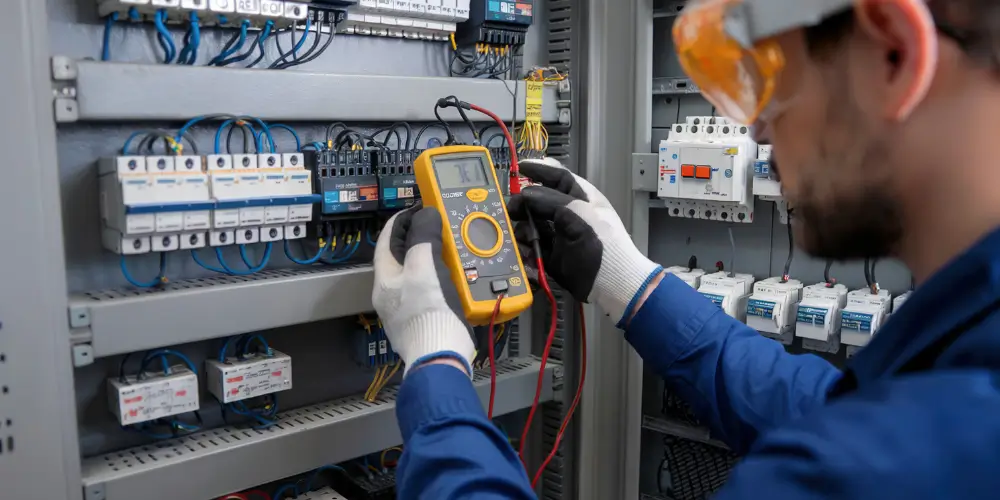
Alongside the visual findings, an EICR includes detailed test results for each circuit, showing whether the hidden parts of the installation perform safely under fault and normal conditions. These measurements let property owners make informed choices about upgrades, usage, and future plans, rather than being constrained by vague risks.
Typically, the report will show:
- Continuity of protective conductors, confirming earth paths are intact
- Insulation resistance, proving cables are not breaking down or leaking current
- Polarity checks, ensuring switches and protective devices operate on the live conductors
- Earth fault loop impedance and RCD test results, showing disconnection will be fast enough
Presented circuit‑by‑circuit, these figures provide transparent evidence of performance, empowering anyone reviewing the EICR to balance safety with the freedom to use the installation confidently.
Recorded Defects and Safety Concerns
Recorded defects and safety concerns form the core of an EICR, clearly setting out where an electrical installation fails to meet current standards or presents a potential hazard. Each issue is listed with a clear description, its location, and a code such as C1, C2, C3, or FI, indicating the level of risk and the urgency of further investigation.
The report normally highlights damaged accessories, exposed live parts, inadequate earthing or bonding, overloaded circuits, deteriorated insulation, and outdated or non-compliant equipment. It also records missing RCD protection where it is now required, as well as signs of overheating, arcing, or unsafe DIY alterations. By making these dangers visible and specific, the EICR gives owners the information needed to act on risks before they limit anyone’s freedom to use the space safely.
Overall Satisfactory or Unsatisfactory Result
Once all observations and test results have been assessed, the EICR concludes with an overall judgement of the installation as either Satisfactory or Unsatisfactory. This headline result matters to anyone who wants the freedom to use a property without anxiety about hidden electrical risks. A Satisfactory outcome confirms that no unacceptable danger has been identified under current regulations. An Unsatisfactory result signals that one or more serious issues exist.
To keep this powerful verdict clear, the report should state:
- The exact overall classification: Satisfactory or Unsatisfactory
- The regulation basis used for that decision
- Whether continued use is considered safe under normal conditions
- Any limitations that affect how confidently the result can be relied upon
Electrician Details and Report Declaration
After outlining the remedial work required, the report must clearly identify who carried out the inspection and on what basis their findings can be trusted. This section anchors the EICR to a competent, accountable professional, giving owners the confidence to act or to challenge on solid ground.
Key electrician details typically include:
- Name, business address, and contact information
- Trade body or competent person scheme membership, with registration number
- Evidence of insurance cover and relevant qualifications
- Signature, date of inspection, and report issue date
The report declaration confirms that the installation was inspected in line with current regulations. It also states whether the installation is satisfactory or unsatisfactory, ensuring the document can withstand legal, financial, and practical scrutiny. Before hiring the electrician, check out How to Check EICR Electrician / How to Check if Your Electrician Is Suitable for an EICR.
How Landlords Should Review an EICR
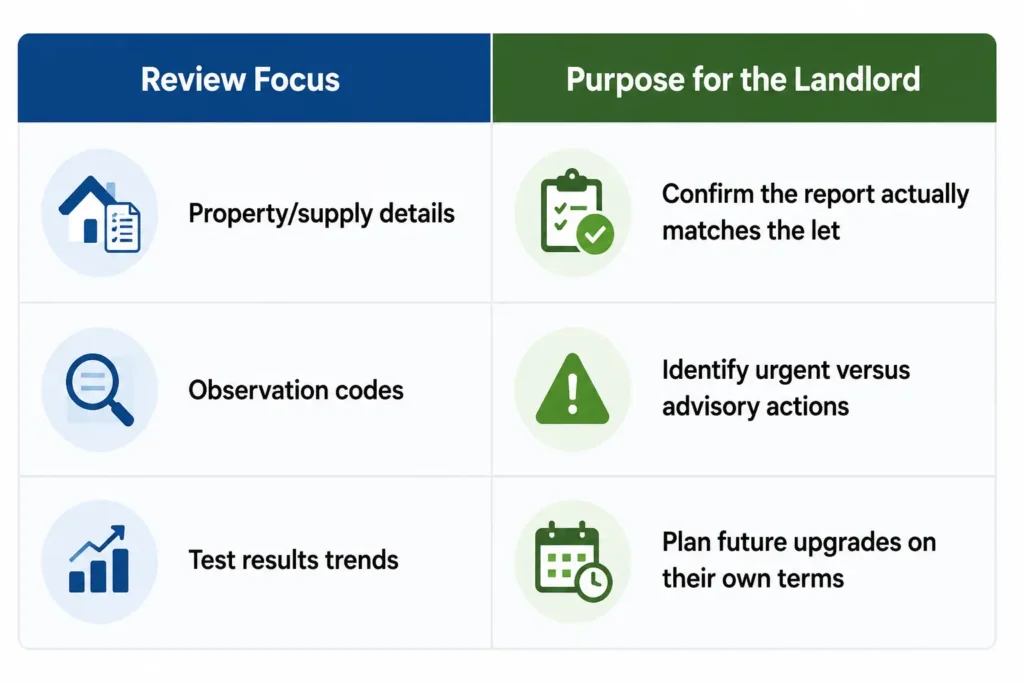
On receiving an EICR, a landlord should review it systematically rather than just checking whether the overall outcome is “satisfactory” or “unsatisfactory.” The document needs to be read in full, confirming basic property and supply details, then focusing on the coded observations and their recommended actions.
Landlords gain real freedom of choice only when they understand the meaning of each code, especially any C1, C2, or FI items that indicate immediate or potentially dangerous risks. They should compare these observations with the schedules of inspections and test results, looking for consistency and any patterns of deterioration.
What to Do With an Incomplete Report
Faced with an incomplete EICR, a landlord should treat it as an unfinished safety assessment rather than a usable compliance document. An incomplete report neither proves compliance nor provides full confidence that tenants can live freely from electrical risk. It limits informed decisions and exposes the landlord to potential legal and practical consequences.
To regain control, a landlord should:
- Identify missing sections such as test results, circuit details, or overall assessment outcome
- Clarify ambiguities by querying vague notes, unexplained codes, or absent signatures
- Record all communication with the inspector to evidence efforts to obtain clarity and completion
- Avoid relying on the document for tenancy decisions, insurance, or legal defence until properly completed
Until then, the report remains a warning, not a safeguard. It usually happens with cheap EICR checks, which few landlords and homeowners prefer due to the low cost.
Arrange a Complete EICR With Landlord Safety Check
For landlords who need a fully compliant, clearly documented EICR, arranging an assessment through Landlord Safety Check provides a structured, end‑to‑end service. This allows owners to stay in control of their properties while meeting strict legal duties without unnecessary restrictions or confusion.
Landlord Safety Check coordinates qualified electricians, schedules visits at flexible times, and guarantees every circuit, protective device, and safety system is inspected and recorded. The resulting report is clear, itemised, and aligned with current UK regulations, making it easier to act only where genuinely necessary.
Where remedial work is required, they outline precise priorities and realistic timescales, enabling landlords to choose how and when to proceed. This approach supports safe, compliant homes without excessive interference.
Frequently Asked Questions
How Often Should a Domestic Rental Property Have an EICR in the UK?
A domestic rental in the UK must have an EICR at least every five years or at each change of tenancy. This schedule balances legal safety duties with a landlord’s freedom to manage property proactively and independently.
Can Tenants Stay in the Property While an EICR Inspection Is Carried Out?
It depends on the situation. The electrician needs access to rooms, sockets, and the consumer unit, causing some disruption, brief power cuts, and movement of belongings, but not requiring temporary relocation. Here are the details for How Long Should You Allow for an EICR Inspection in a Rented Property?
How Long Does a Typical EICR Inspection Take for a Three-Bedroom House?
A typical EICR for a three-bedroom house usually takes 2–4 hours, depending on accessibility and complexity. The electrician tests circuits, inspects sockets, lights, and consumer unit, causing minimal disruption while ensuring the installation remains safe and compliant.
Is an EICR Required Before Selling a Property, or Only for Rentals?
An EICR is legally required for most rentals, not standard for selling. However, many freedom‑minded sellers commission one voluntarily to prove safety, empower informed choice, reduce disputes, and smooth negotiations with cautious buyers and their mortgage lenders.
Are Portable Appliance Tests (PAT) Included in an EICR by Default?
No. PAT is not included in an EICR by default. The EICR covers fixed wiring only; portable appliance testing is a separate, optional service that must be specifically requested or contracted if someone wants it.
Conclusion
In conclusion, understanding the EICR report checklist and what should be included in an EICR report helps landlords, homeowners, and agents guarantee electrical safety and legal compliance. By recognising the difference between a report and a certificate, checking key details such as property information, installation condition, and electrician credentials, and knowing how to respond to incomplete or unsatisfactory documents, duty holders can act responsibly. When in doubt, arranging a thorough, compliant EICR with a trusted provider safeguards both occupants and property.