
An EICR provider checklist for landlords in London covers eight essentials. First, confirm the electrician’s qualifications and specific EICR training. Check their experience with local rentals and HMOs. Verify registration with NICEIC, NAPIT, or similar schemes. Clarify exactly what the quoted price includes. Confirm the full inspection scope and access needs. Check professional insurance details. Review recent landlord feedback. Finally, compare more than just price to understand what truly defines a reliable EICR service.
Key Takeaways
- Confirm the electrician’s qualifications, scheme registration (e.g. NICEIC, NAPIT) and insurance, and verify details using official online registers.
- Check their EICR experience with London rentals (HMOs, flats, conversions) and ask for sample reports and a written inspection scope.
- Ensure they clearly explain EICR codes (C1, C2, C3, FI), safety implications, and how findings affect tenancy and legal compliance.
- Demand transparent pricing: itemised quote including VAT, travel, parking, overruns, missed appointment charges, and how extra issues are cost.
- Review recent landlord feedback and references, focusing on punctuality, report clarity, communication, and thoroughness over just the cheapest price.
Table of Contents
Check the Provider’s Electrical Qualifications And Verify
Competence starts with verified credentials, so landlords must confirm that any EICR provider holds the appropriate electrical qualifications and registrations. A provider should be a qualified electrician with City & Guilds or equivalent Level 3 electrical qualifications and specific EICR training. Registration with recognised bodies such as NICEIC, NAPIT, or ELECSA gives landlords traceable proof of compliance with UK wiring regulations.
They can verify membership by using the official online registers, entering the contractor’s name, company, or registration number. If details do not match, the provider should be rejected. Genuine contractors will share their registration evidence without hesitation. Scheme registration also supports insurance compliance and demonstrates that testing and reporting should follow current BS 7671 standards, helping landlords protect tenants, property, and long‑term flexibility in how they manage their portfolio.

Confirm Their EICR Inspection Experience
Verifying qualifications is only one part of the screening process; landlords must also confirm how much real-world EICR inspection experience a provider has. Experience determines how quickly and accurately an electrician can assess a property, identify risk, and suggest practical remedies without over-specifying work.
Landlords should ask how many EICRs the provider completes each month, and in what types of properties HMOs, studio flats, large Victorian conversions, or modern developments. London housing stock is diverse; experience across older wiring systems and modern installations matters.
They should also request sample reports, paying attention to clarity, consistency of coding, and balanced recommendations. Finally, asking how the provider handles borderline findings reveals whether they lean toward fair, safety-focused judgment rather than unnecessary restrictions or excessive remedial work. Explore more about how to check if your electrician is suitable for an EICR.
Ask What the Quoted Price Includes
Surprisingly often, landlords only discover hidden extras after an EICR visit has finished and the invoice arrives. To stay in control of costs, they should ask providers to itemise exactly what the quoted fee covers. A written breakdown prevents last‑minute pressure and protects their ability to choose freely.
They may seek clarity on whether the quote includes travel, congestion or parking charges, VAT, production of the formal EICR report, and any administrative fees for issuing certificates to agents or councils. Time‑related costs also matter: is there a call‑out charge if tenants miss the appointment, or an hourly rate if the inspection overruns? Transparent pricing lets landlords compare providers on real value, avoid lock‑ins, and keep their properties compliant without surprise expenses.
Confirm the Full Inspection Scope
Before confirming a booking, a landlord should pin down exactly what the electrician intends to inspect and test as part of the EICR. The scope determines how much real assurance they gain over the safety of their property and the freedom to rent without hidden risks.
They should request a written breakdown covering the consumer unit, all accessible wiring, protective devices, earthing and bonding, fixed accessories (sockets, switches, light fittings), and any hard‑wired equipment such as cookers, showers, and extract fans. Clarifying whether communal or external areas, outbuildings, and garages are included prevents unwelcome surprises later.
A provider willing to map out the full inspection scope upfront is less likely to cut corners and more likely to deliver a defensible, regulation‑compliant report. Check out the EICR inspection checklist for London landlords.
Check How Circuits Will Be Sampled
Landlords in London should ask prospective EICR providers exactly how they intend to sample circuits, rather than assuming every circuit will be fully tested. Sampling strategies directly affect how confidently a landlord can say the installation is safe and compliant, while still keeping costs and intrusion under control.
A competent provider should explain what proportion of circuits will be tested and why that level is sufficient for the property’s age, use, and risk profile. Landlords remain responsible, so they need clarity, not vague reassurances. Key questions include:
- What percentage of circuits in each distribution board will be tested?
- How will you choose which circuits to test?
- When would you move from sampling to full testing?
- How will sampling decisions be documented in the report?
Ask About Access and Power Disruption
When arranging an EICR in London, it is essential to clarify exactly what access the electrician will need and how long power will be interrupted in each area of the property. A freedom‑minded landlord wants minimal interference with tenants’ daily lives, so the provider should explain which rooms, cupboards, meters, and communal spaces must be opened and when.
They should also outline where full isolation is required and where temporary shutdowns will occur, such as kitchens, home offices, or Wi‑Fi routers. Clear advance information allows tenants to decide how to work, study, or relax during the visit, rather than being forced into last‑minute disruption. Landlords can then coordinate keys, permissions, and notice periods while keeping occupation as unrestricted as possible.
Confirm the Expected Inspection Duration
Although every property is different, a competent EICR provider should be able to give a realistic time estimate for the inspection and any testing‑related downtime. Landlords who value flexibility need to know how long circuits may be isolated and when rooms will be unavailable, so they can avoid unnecessary constraints on their day and their tenants’ routines.
They should press providers for clear time bands and what might extend them. A precise discussion might cover:
- Typical duration for similar‑sized properties and occupancy types
- How many electricians will attend and what each will handle
- When high‑disruption tests will occur, so work‑from‑home tenants can plan
- Contingency time if hidden defects appear, and how that will be communicated
Defined timings protect both autonomy and expectations. Learn how long you should allow for an EICR inspection in a rented property.
Review Their EICR Reporting Process
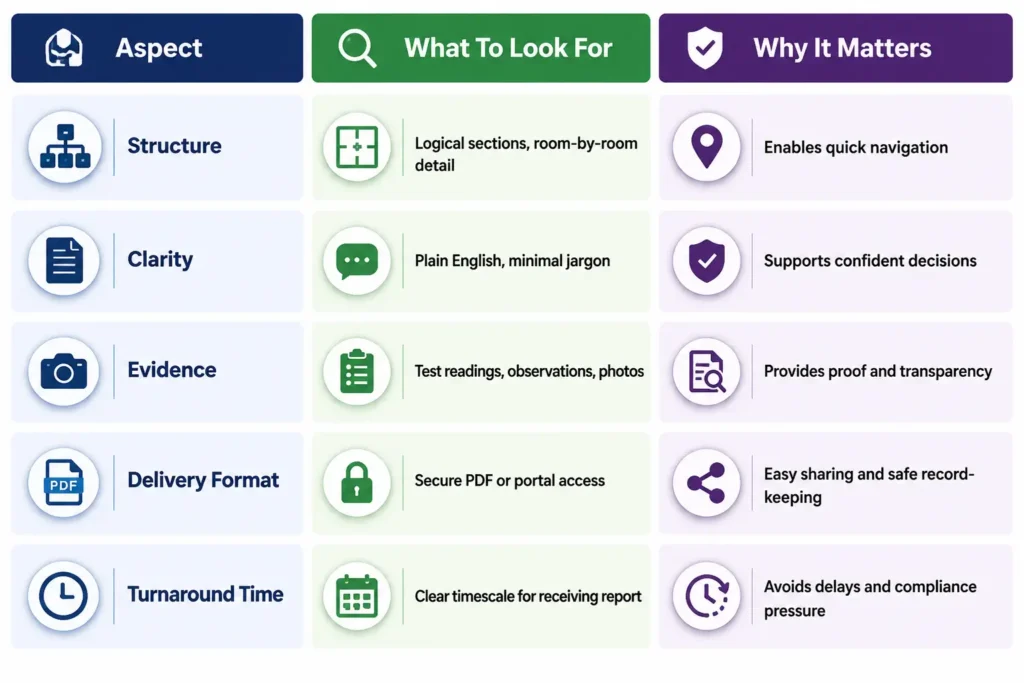
Scrutinising how an electrician records and delivers an EICR is as important as the inspection itself. A landlord who values freedom from hassle and surprise needs a report that is structured, clear, and easy to act on. The provider should explain how findings are laid out, how recommendations are prioritised, and how follow‑up work is separated from advisory comments.
Check How Defect Codes Are Explained
A clear report structure is only useful if the landlord understands what each observation actually means, so the way an electrician explains defect codes needs careful attention. London landlords who value flexibility and control should insist on plain-language interpretations of C1, C2, C3 and FI codes, not just technical jargon. Each code should spell out the practical risk, legal implications, and what level of urgency it really represents. Here is the detail of EICR codes.
Landlords can test an EICR provider by asking them to explain, in everyday terms:
- What each code means for safety and compliance
- How the code affects the ability to let or continue a tenancy
- Whether the issue limits how tenants can use the property
- How to prioritise issues so disruption and restrictions stay minimal
Ask About Remedial Work Arrangements
When choosing an EICR provider, it is essential to understand exactly how remedial work will be handled once defects are identified. Landlords who value flexibility will want to know whether the inspector insists on doing the repairs themselves or is happy for another qualified electrician to complete them.
They should ask for a clear breakdown of costs, timescales, and priorities for each recommended action. It is sensible to confirm whether quotes are fixed or subject to change, and what happens if additional issues emerge during repairs.
Landlords may also seek written confirmation that all remedial work will be certified and accompanied by updated documentation, ensuring the property can be legally re-let without delay and without being locked into a restrictive arrangement.
Check Their Professional Insurance Cover
One essential safeguard is verifying that an EICR provider carries appropriate professional insurance, including public liability and professional indemnity cover. This protects landlords from being financially trapped by another party’s mistakes, preserving both flexibility and control over their property strategy. Insurance should be current, adequate for the portfolio’s scale, and documented in writing.
Landlords may wish to request and confirm:
- Evidence of public liability cover high enough for potential injury or property damage claims
- Proof of professional indemnity insurance that covers inspection errors or omissions
- Policy dates, exclusions, and any limitations affecting high-value or multiple-occupancy properties
- Written confirmation that subcontractors are equally insured
Review Recent Landlord Customer Feedback
Reputation becomes measurable through recent, detailed feedback from other landlords who have used the same EICR provider in London. By scanning reviews on independent platforms, social media groups, and landlord forums, a landlord can quickly see patterns: punctuality, clarity of reports, respect for tenants’ time, and responsiveness when issues arise.
They should focus on feedback posted within the last 6–12 months, because regulations, staff, and working practices change. Comments describing rushed inspections, surprise add‑on costs, or poor communication signal constraints and potential hassle. In contrast, reviews highlighting thorough explanations, flexible booking, and minimal disruption suggest a provider that supports a landlord’s autonomy.
Where possible, landlords may request references from other portfolio owners with similar property types.

Compare Providers Beyond the Cheapest Quote
Price alone obscures the real value of an EICR provider, especially in a competitive market like London. Landlords who want real freedom from stress and repeat visits look past headline prices and examine what is genuinely included. A low fee can mask rushed inspections, vague reports, or extra “add‑on” charges that erode both time and control.
They assess whether each quote protects their properties, their tenants, and their ability to act decisively:
- Depth and clarity of the written EICR report
- Time allocated on site for thorough testing, not quick box‑ticking
- Professional credentials, insurance, and complaint routes
- Transparency of pricing for remedial work, revisits, and certification
Book a Trusted London EICR Provider
After comparing more than just the headline quote, a landlord ultimately needs to decide who will carry out the inspection and get the booking confirmed. At this stage, they focus on securing a provider who protects their time, income, and legal position, rather than adding new constraints.
A trusted London EICR provider offers clear availability, written confirmation of the appointment, and a precise arrival window. They explain what access is required, how long the inspection will take, and how disruption to tenants will be minimised.
Before booking, the landlord confirms fees, payment terms, and what is included: the full EICR report, digital copies, and any revisit charges. Transparent cancellation and rescheduling policies further safeguard the landlord’s flexibility and control.
Frequently Asked Questions
Can One EICR Cover Multiple Flats Within the Same Building?
No, each flat usually requires its own EICR, as every dwelling is a separate electrical installation. This individualized certification protects tenants’ safety while giving landlords clear, independent proof of compliance and freedom from disputes over shared system responsibilities.
How Often Should Landlords Renew an EICR in London Rentals?
They must renew an EICR at least every five years, or sooner if the report states a shorter interval. They also need a new certificate after major electrical works or when safety concerns or tenant changes suggest risk.
Does an EICR Include Testing Smoke and Heat Alarms in the Property?
An EICR usually focuses on fixed wiring, so smoke and heat alarms are not automatically tested. However, many electricians offer alarm testing alongside the report; freedom-minded landlords can request this explicitly in their inspection brief.
What Happens if I Lose My EICR Report After the Inspection?
They can request a duplicate EICR from the original electrician or company, usually stored digitally. If unavailable, they may need a new inspection, since landlords must be able to produce a valid, current report when challenged.
Are EICR Findings Shared With Tenants or Only Kept by the Landlord?
EICR findings are not secret; in many cases tenants have a right to see them. Landlords usually keep the original report but must share copies or key outcomes, especially when safety issues or legal obligations exist.
Conclusion
To summarise the EICR provider checklist, landlords in London benefit from choosing EICR providers carefully rather than relying on price alone. By checking qualifications, scheme registration, inspection scope, and relevant insurance, they reduce the risk of non‑compliant or incomplete reports. Reviewing landlord feedback and confirming exactly what the quote covers further protects both property and tenants. With a trusted, experienced EICR provider, landlords can meet legal obligations confidently and maintain safer, more reliable rental homes.