
Is boiler servicing included in a gas safety check? In the UK, a routine gas safety check does not automatically include a full boiler service. A gas safety check focuses on legal safety compliance of all gas appliances and issues a CP12 for landlords. A boiler service is a deeper clean and performance check of the boiler itself to improve efficiency and reliability. Landlords are legally required to have annual gas safety checks, while servicing is best practice. The differences, timings, and benefits are explored in more detail next.
Key Takeaways
- A gas safety check and a boiler service are separate tasks; a standard legal CP12 check does not automatically include a full boiler service.
- By law, UK landlords must have an annual gas safety check and CP12, but a boiler service is recommended maintenance, not a legal requirement.
- A gas safety check focuses on legal compliance and basic safety of all gas appliances, pipework, and flues, not deep cleaning or performance optimisation.
- A boiler service involves internal inspection, cleaning, and performance testing of the boiler to improve efficiency, reliability, and lifespan.
- Some engineers or agents offer combined visits, but you must specify if you want both a gas safety check and a full boiler service.
Table of Contents
Is Boiler Servicing Included in a Gas Safety Check?
When arranging a gas safety check, many people wonder whether a full boiler service is automatically included. In the UK, a gas safety check and a boiler service are separate tasks, even if carried out by the same Gas Safe registered engineer. A standard gas safety check focuses on legality: it confirms that gas appliances are safe to use, correctly installed, and not leaking gas or carbon monoxide.
A boiler service goes further. It typically involves taking the boiler casing off, cleaning internal components, checking system efficiency, and testing performance against manufacturer specifications. Some engineers offer combined visits, but a gas safety check alone does not guarantee the boiler has been fully serviced.
Individuals who value control over their home and costs should specify exactly what they want when booking: a gas safety check, a boiler service, or both, and confirm this in writing before work begins.

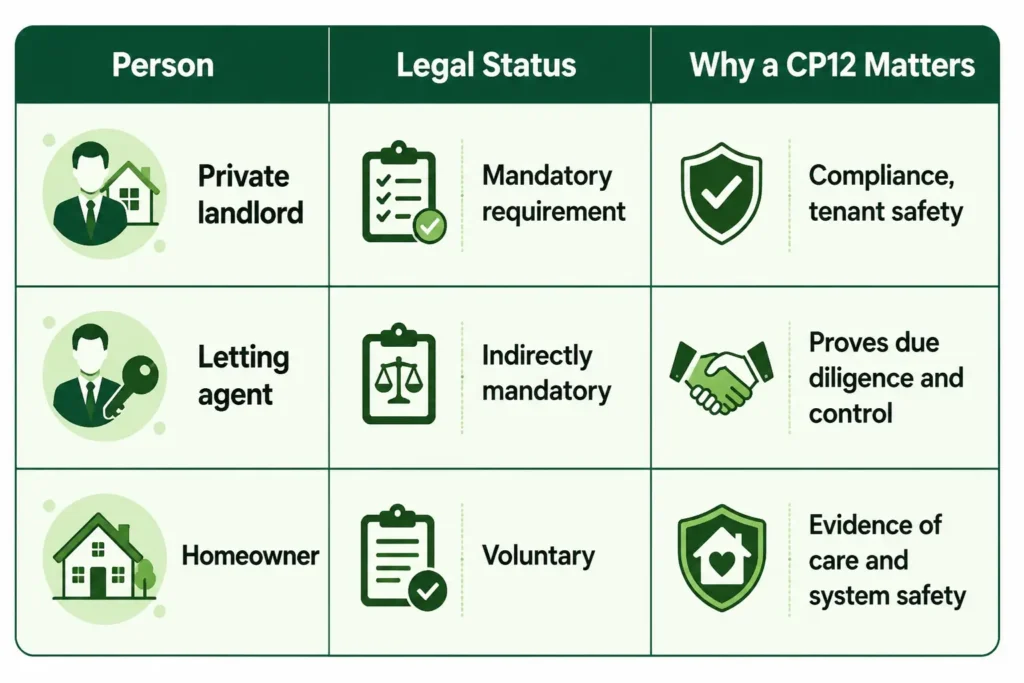
Who Needs a CP12 Gas Safety Record?
Understanding the difference between a boiler service and a gas safety check naturally raises another question: who actually needs formal proof that these checks have been done? In the UK, the CP12 Gas Safety Record is a legal requirement for landlords who rent out residential property with gas appliances. It documents that a Gas Safe registered engineer has confirmed the system is safe on the date of inspection.
Homeowners are not legally required to hold a CP12, but many choose to, treating it as a passport to peace of mind, smoother sales, and fewer disputes with insurers. Letting agents also rely on CP12s to demonstrate compliance on behalf of their landlord clients.
What Is Checked During a Gas Safety Check?
During a gas safety check, a Gas Safe registered engineer carries out a structured inspection of all gas appliances, pipework, and flues to verify they are operating safely and efficiently. The process is focused on compliance and risk reduction, giving occupants the confidence to use their heating and hot water without restriction or worry.
Typically, the engineer will:
- Verify each gas appliance has adequate ventilation and is correctly installed to manufacturer and legal standards.
- Check the gas meter, visible pipework, and emergency control valve for leaks, damage, or unsafe alterations.
- Test burner pressure and gas rate to ascertain the appliance is operating within safe limits.
- Assess flue integrity and termination to verify combustion products are dispersing safely outdoors.
- Use appropriate instruments to check for signs of dangerous combustion, including carbon monoxide risk.
The outcome is recorded, usually on a CP12 or equivalent gas safety record.
How a Gas Safety Check Differs From a Boiler Service
A gas safety check focuses on confirming that all gas appliances, pipework, and flues in a property are safe to use and meet legal standards, rather than optimising performance or efficiency. By contrast, a boiler service is a deeper, performance‑driven procedure centred on a single appliance: the boiler. It involves cleaning, adjustment, and preventive care to keep it running smoothly, quietly, and efficiently. Explore What Happens if a Boiler Fails a Safety Check? Repairs, Risks and Next Steps London Landlords Need to Know
In essence, the gas safety check asks, “Is everything safe right now?” while the boiler service asks, “Is this boiler protected, efficient, and less likely to fail?”
Key differences include:
- Scope: entire gas installation versus one boiler.
- Aim: legal compliance and immediate safety versus long‑term performance.
- Depth: visual and instrumental checks versus component cleaning and calibration.
- Time: typically shorter inspection versus more involved servicing.
- Outcome: safety record versus detailed service history and performance insights.
Which Service Is Legally Required for Landlords?
In the context of UK rental law, only the annual gas safety check is a legal requirement for landlords, not a routine boiler service. The Gas Safety (Installation and Use) Regulations 1998 require landlords to arrange a gas safety check every 12 months for all gas appliances and flues provided with the property. This check must be carried out by a Gas Safe registered engineer.
Landlords must also provide tenants with a valid Gas Safety Record before they move in, and within 28 days of each annual check. Failure to comply can lead to enforcement action, fines, and potential criminal liability, which can restrict a landlord’s ability to manage property on their own terms. A boiler service, by contrast, is strongly recommended but optional in law. It becomes compulsory only if written into tenancy agreements, insurance conditions, or warranty terms, rather than by statute itself.
Can One Service Replace the Other?
How clearly can the distinction be drawn between these two procedures? A gas safety check verifies that gas appliances meet legal safety standards at a specific moment. A boiler service, however, goes deeper: cleaning components, optimising performance, and reducing the risk of breakdown. One cannot reliably substitute for the other, even though both are carried out by Gas Safe registered engineers and often occur during the same visit.
A safety check focuses on compliance and immediate danger; a service focuses on long‑term efficiency, comfort, and autonomy over energy use. To treat them as interchangeable narrows options and increases risk.
- A gas safety check may include basic boiler observations, not full maintenance.
- A boiler service may not generate the legally required landlord certificate.
- Safety checks are snapshot assessments; services are preventative care.
- Combining both in one visit is possible but must be specified.
- Relying on one alone reduces control over cost, safety, and reliability.
When Should Each Service Be Booked?
Timing each visit correctly protects both safety and budget. A gas safety check is typically booked every 12 months, but many people prefer to schedule it at the same time each year, just before peak winter use. That rhythm lets them prove the appliance is safe and spot emerging issues before heavier demand.
A boiler service is also usually annual, yet offers more flexibility. Many choose late summer or early autumn, when engineers are less busy and any parts can be replaced before cold weather limits options. Others align the service with the boiler’s installation anniversary to keep warranties valid.
Both bookings are worth advancing when warning signs appear: irregular flames, frequent pressure drops, strange noises, or rising gas use. After any major property works affecting ventilation or flues, arranging checks sooner gives homeowners freedom to use heating and hot water without second‑guessing hidden risks.
Do Landlords Need Both Services?
Although the law may seem confusing at first glance, a landlord’s core legal duty is clear: an annual gas safety check, documented with a valid Gas Safety Record, is mandatory for all gas appliances and flues they own in a rental property. Here you get Why Annual Gas Safety Checks Are Essential for Landlords and Homeowners?
A boiler service, however, is not legally required under UK regulations, even though many managing agents present it as standard practice.
From a freedom‑focused perspective, the question becomes: is it wise, not “is it forced”? Many landlords choose both because a full service protects long‑term autonomy over costs, downtime, and disputes.
- Gas safety check: a legal, pass/fail snapshot of safety at one point in time.
- Boiler service: deeper inspection, cleaning, and performance optimisation.
- Regular servicing can reduce breakdowns that restrict tenant comfort and increase call‑outs.
- Evidence of servicing can strengthen a landlord’s position in insurance or deposit disputes.
- Choosing both services is a strategic decision, not an automatic obligation.
Frequently Asked Questions
How Much Does a Gas Safety Check and Boiler Service Typically Cost?
A UK gas safety check typically costs £60–£90, while a full boiler service usually ranges from £80–£130. Prices vary by region, property type, and provider, so individuals often compare quotes to keep options open.
Can Tenants Request an Additional Boiler Service From Their Landlord?
Yes, tenants can request an additional boiler service, but landlords are not legally obliged to agree. Tenants may negotiate, offer to share costs, or arrange their own service, provided access and safety obligations remain respected.
Does Home Insurance Require Proof of Regular Boiler Servicing?
Home insurance sometimes demands proof of regular boiler servicing, but it depends on the specific policy. Freedom‑minded homeowners should check policy documents carefully, since missing servicing conditions can reduce cover or invalidate related boiler damage claims.
Are Gas Safety Checks and Boiler Services Covered by Boiler Cover Plans?
They are sometimes covered, sometimes not; it depends entirely on the specific boiler cover plan. Consumers must read inclusions carefully, as some policies bundle annual service and checks, while others only cover breakdowns and emergency repairs.
How Long Do Gas Safety Checks and Boiler Services Usually Take?
Gas safety checks usually take 20–40 minutes, while full boiler services typically last 45–90 minutes. Duration varies with boiler age, access, and faults, but efficient engineers keep disruption minimal, letting occupants quickly reclaim their space and routine.
Conclusion
To summarize, a gas safety check and a boiler service are complementary but distinct. The gas safety check (CP12) is a legal requirement for landlords, confirming appliances are safe, while a boiler service focuses on performance, efficiency and preventing breakdowns. One cannot fully replace the other. Landlords and homeowners should book an annual gas safety check where required and schedule regular boiler servicing to protect tenants, safeguard properties and maintain reliable heating and hot water.