
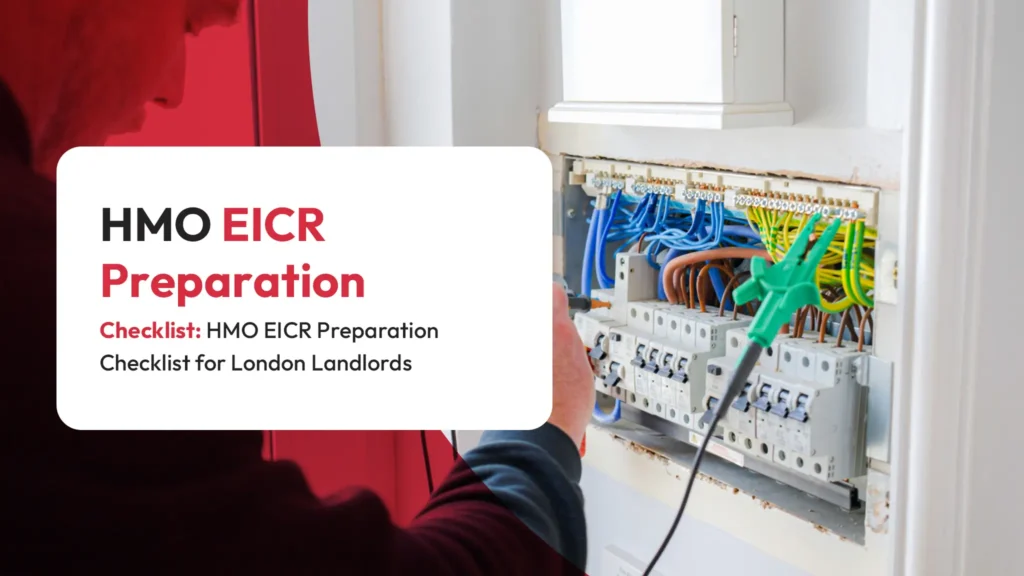
An HMO EICR preparation checklist for London landlords explains how to book and confirm the inspection date, notify tenants and arrange access to all rooms, and clear communal areas so electricians can work safely. It covers gathering past EICRs and certificates, understanding basic test stages, and interpreting C1–C3 and FI codes. It also outlines how to plan remedial works and ongoing inspections so landlords can keep properties compliant, avoid fines and improve tenant safety as the guidance unfolds.
Key Takeaways
- Confirm a fixed EICR date with a qualified electrician, then give tenants written notice with access arrangements for all rooms and locked areas.
- Clear and tidy communal and electrical areas, remove clutter and unsafe extensions, and ensure good lighting and unobstructed access to consumer units and meters.
- Gather previous EICRs, installation and minor works certificates, and highlight any unresolved issues or past C1–C3 or FI observations for the electrician.
- Understand EICR codes: C1 and C2 mean “unsatisfactory,” C3 recommends improvements, and FI needs further investigation before compliance can be confirmed.
- After the EICR, schedule and document remedial works, keep records securely, and plan periodic checks and proactive upgrades to maintain ongoing compliance.
Table of Contents
Why HMO EICR Preparation Matters
Many landlords underestimate how critical proper preparation is before an HMO Electrical Installation Condition Report (EICR) inspection. Preparation is not bureaucracy for its own sake; it is what keeps fines, enforcement notices, and disruptive remedial works from eroding a landlord’s income and autonomy.
When a property is electrically safe and well‑documented, inspections run faster, tenants feel secure, and void periods shrink. Clear evidence of care also helps if a dispute arises with insurers, councils, or tenants. For London landlords operating under intense regulation, preparation becomes a way to stay ahead of inspectors rather than react to them.
In practice, effective preparation protects cash flow, reduces interference from authorities, and allows landlords to manage their HMOs on their own terms. Explore Electrical Safety Check Vs EICR: What Should Landlords Arrange?

First Confirm Your EICR Inspection Date
Before any sockets are tested or consumer units opened, the landlord or managing agent must first pin down and confirm the EICR inspection date. Securing a firm date with a qualified electrician creates a clear window of time where access, disruption, and responsibilities are defined, not guessed. This allows the landlord to preserve personal freedom and flexibility while still meeting legal obligations.
They should request written confirmation of the date, start time, and estimated duration, plus any specific inspection requirements. In London, where diaries fill fast, confirming early avoids last‑minute scrambling and premium emergency rates. A confirmed date also acts as the anchor for the rest of the HMO EICR preparation checklist, ensuring every subsequent step is purposeful rather than reactive.
Notify Tenants About the Electrical Visit
Clear communication with tenants is essential once an EICR inspection date is confirmed, as it sets expectations and reduces disruption. A London HMO landlord should notify every tenant in writing, using channels they actually check email, messaging apps, or letters while respecting their preference for minimal intrusion.
The notice should clearly state the inspection date, approximate time window, the electrician’s name or company, and why the EICR is required: to keep the property electrically safe and legally compliant. Tenants should be reassured that the visit is routine, not an inspection of lifestyle or personal choices.
Providing reasonable notice, typically at least 24–48 hours, demonstrates respect for tenants’ autonomy and gives them space to plan their day around the brief disturbance. Here is the detailed guidance on Tenant Access Checklist: EICR Tenant Access Checklist for EICR Inspections.
Arrange Access to All Rooms and Areas
Once tenants have been informed about the EICR visit, the landlord must guarantee the electrician can access every area where fixed wiring or consumer units may be present. That means arranging entry to all bedrooms, living spaces, kitchens, bathrooms, storage cupboards, basements, and any locked rooms that might contain electrical installations.
To avoid tension, the landlord should agree to access windows with tenants in advance, confirming dates and approximate time slots in writing. Where individual rooms are lockable, they should provide keys or access codes on the day, without forcing unnecessary intrusion.
If tenants prefer to be present, visits can be staggered to respect work patterns and personal freedom, while still allowing a complete, uninterrupted inspection.
Check Communal Electrical Areas
Communal electrical areas in an HMO such as hallways, stairwells, meter cupboards, shared kitchens, and plant rooms should be systematically checked and tidied before the EICR. A landlord who prepares these spaces well gives the inspector clear access, reduces delays, and protects occupiers’ freedom to move safely around the building.
They should guarantee lighting operates reliably, with intact switches, covers, and diffusers. Any exposed wiring, damaged accessories, or loose trunking must be identified and noted for the electrician. Socket outlets in shared kitchens and lounges should be accessible, not buried behind appliances or furniture.
Landlords should also clear combustible clutter from around electrical equipment, confirm that access routes remain unobstructed, and remove makeshift extensions or daisy-chained multi‑way adaptors from communal areas.
Prepare Consumer Units and Distribution Boards
Consumer-unit readiness is central to a smooth HMO EICR, because these enclosures are where most safety‑critical checks take place. A landlord who wants maximum freedom from future restrictions guarantees each consumer unit and distribution board is fully accessible, well‑lit, and not hidden behind stored items or locked cupboards without keys on site.
Covers should be intact, labelled, and free from ad‑hoc openings or taped repairs. Circuit schedules must be legible and aligned with the actual layout of the HMO, so the inspector can trace supplies to kitchens, bathrooms, and communal spaces without guesswork.
Landlords often arrange for loose fronts, missing blanks, and obvious signs of overheating or burning to be rectified beforehand, reducing the risk of follow‑up disruption.
Check Previous EICR Reports and Repairs
After the physical condition of consumer units has been checked, attention should turn to paperwork from previous inspections. A landlord who wants genuine flexibility in let management benefits from knowing exactly what has been flagged before. They should locate earlier EICR certificates, minor works certificates, and any test sheets, then confirm inspection dates, inspector details, and overall outcomes.
They then review all observations and classification codes, highlighting anything that might still affect safety or compliance. Cross‑referencing these notes with present conditions helps identify patterns: recurring faults, weak points in the installation, or areas where tenants frequently interfere. This evidence‑based view allows a landlord to plan upgrades on their own terms, budget intelligently, and avoid being boxed into rushed decisions during the new EICR.
Complete Outstanding Electrical Repairs
Prioritising unresolved issues comes next: any defects, recommendations, or limitations recorded on previous EICRs should be translated into a clear repair list before new testing is booked. Landlords who want maximum flexibility later recognise that unfinished work today quickly turns into restrictive conditions or even enforcement.
They typically group repairs by urgency, then instruct a qualified electrician to eliminate all C1, C2 and FI items, and to address significant C3 observations wherever they might limit safe use of the property.
| Priority Level | Example Issues | Desired Outcome |
| Urgent | Exposed live parts, burning smells | Immediate removal of danger |
| High | Missing bonding, damaged accessories | Robust protection for everyday freedom |
| Planned | Aging fittings, loose accessories | Future‑proofed installation and comfort |
Once completed, repairs should be visually checked before the electrician arrives for the new EICR. How Often Should Landlords Check Electrical Safety Before an EICR?
Gather Electrical Safety Documents
Organising key paperwork in advance allows the inspection to run efficiently and reduces the risk of follow‑up visits. A prepared landlord keeps control of their time, minimising disruption for themselves and their occupiers.
They should collect previous EICRs, installation certificates, minor works certificates, and records for any consumer unit upgrades or rewires. Manuals and test sheets for fixed equipment such as electric showers, storage heaters, or hard‑wired appliances should be stored together. Evidence of fire alarm and emergency lighting installation or servicing, where applicable, is also useful.
All documents are best filed in a single digital and physical folder, clearly dated and labelled by circuit or area. This level of organisation lets the inspector work faster and issue a focused, accurate report.
What Happens During an HMO EICR?
An HMO EICR begins with the electrician confirming access to all areas and visually evaluating the condition of the installation, looking for obvious damage, overloading, or non‑compliant alterations. They move systematically through the property, checking consumer units, earthing and bonding, and the layout of circuits that feed each room and communal space.
They then carry out “dead” tests with the power off, measuring continuity, insulation resistance, and polarity to verify that conductors and protective devices work as intended. Next, they perform “live” tests, such as fault‑loop impedance and RCD trip‑time checks, confirming that disconnection will occur fast enough during a fault. Portable or plug‑in equipment may be spot‑checked, and accessible accessories opened to inspect connections and signs of overheating. How Long Should You Allow for an EICR Inspection in a Rented Property?

After the HMO EICR Inspection
Once the HMO EICR inspection is complete, attention shifts to understanding the written report and its coding. The electrician’s observations are translated into clear classifications, typically C1, C2, C3, or FI. Each code signals how urgent action is required and how far the current installation is from a safe, low‑stress living environment.
A C1 or C2 finding usually means the report is “unsatisfactory,” limiting a landlord’s freedom to let the property until hazards are removed. C3 indicates recommended improvements, giving scope to plan upgrades on their own terms. FI calls for further investigation before informed decisions can be made. Landlords then decide who will complete remedial works, how to schedule access with minimal disruption, and when to obtain written confirmation of corrections. Explore the EICR codes in detail.
Maintaining HMO Electrical Compliance
Maintaining HMO electrical compliance demands more than a one‑off EICR; it relies on structured, ongoing management. Landlords who value freedom of operation recognise that strong systems protect both tenants and their own autonomy. They schedule periodic visual checks, swiftly action C1–C3 codes, and document every change to wiring, accessories, or consumer units.
| Focus Area | Landlord Action | Freedom Benefit |
| Routine Checks | Log monthly inspections and test points | Fewer surprises, more control |
| Record Keeping | Store EICRs, certificates, invoices | Clear proof if challenged by authorities |
| Upgrades & Repairs | Plan proactive improvements, not quick fixes | Long‑term stability and flexibility |
Frequently Asked Questions
How Much Does an HMO EICR Typically Cost in London?
An HMO EICR in London typically costs £150–£350, depending on property size, circuits, and electrician. Landlords seeking flexibility often compare quotes, confirm qualifications, and bundle remedial works to keep both safety compliance and personal autonomy intact.
Who Is Qualified to Carry Out an HMO EICR Inspection?
Only a registered, competent electrician holding current BS 7671 qualifications and suitable inspection-and-testing certification may carry out an HMO EICR. They must be appropriately insured, experienced with HMOs, and ideally registered with NICEIC, NAPIT, or similar.
How Often Must an EICR Be Renewed for HMOS in London?
An HMO EICR in London must be renewed at least every five years, or sooner if the report specifies a shorter interval, ensuring tenants’ safety while allowing landlords predictable, periodic checks rather than constant intrusive inspections.
What Penalties Can Landlords Face for Not Having a Valid EICR?
Landlords risk civil penalties up to £30,000, enforcement notices, potential prohibition of property use, difficulty serving eviction notices, invalidated insurance, and liability for tenant injury or death, severely restricting their control, income, and long‑term property freedom.
Does Landlord Insurance Require a Current EICR for HMO Properties?
Landlord insurance often expects a current EICR for HMOs, though policy wording varies. Insurers may refuse cover, limit claims, or increase excess without it, making a valid EICR essential for financial protection and operational freedom.
Conclusion
For London HMO landlords, getting HMO EICR preparation organised before an EICR visit makes the process smoother, quicker and more accurate. By confirming inspection dates, notifying tenants, arranging access, checking communal areas and gathering paperwork, they help electricians carry out thorough assessments. Following any remedial recommendations promptly and keeping ongoing records then protects tenants, reduces risk of electrical incidents and guarantees the property remains fully compliant with HMO electrical safety regulations over the long term.